
Guidebooks are annoying. Just because some editor who doesn’t know me tells me which restaurant is the best or what attraction is a must-see doesn’t make it a must-see attraction. Sightseers’ Delight is dedicated to the weird, the quirky and the fun. After all, traveling is fun.
If it’s not, you’re doing it wrong.
All of the places highlighted in this ever-growing database are great. Sightseers’ Delight has visited them all. We think you should make a point to see every one of them. But, this is not a guidebook. Just a webpage to help you plan your next adventure.
Built in 1721, a dozen years before the first city in Georgia, Savannah, was founded, Fort King George was both the first English settlement on Georgia’s coast and the British Empire’s southernmost outpost in North America. It remained the southernmost settlement until 1736 when Fort Frederica was built on what is today St. Simon’s Island. With the help of historic drawings, the Lower Altamaha Historical Society and the Georgia Department of Natural Resources in 1988, a number of the fort’s structures were rebuilt, including the cypress blockhouse. The reconstructed fort is a replica of Barnwell’s original construction. Today, the park highlights the area’s 18th century cultural history, including the Guale Indians, the 17th century Spanish mission Santo Domingo de Talaje, Fort King George and the Scottish colonists. In addition, the state park features information about 19th century sawmilling.
31305
Hearst named his mansion La Cuesta Enchantada (or The Enchanted Hill), but it is commonly referred to as Hearst Castle. The Casa Grande that stands atop the hillside, the symbol of the mansion, features two towers were inspired by the Cathedral of Santa Maria la Mayor in Ronda, Spain. The Castle is filled with Hearst’s collection of treasures from around the world, ranging from medieval tapestries to Renaissance furniture to 19th century sculptures. But, perhaps the most intriguing element of the mansion is Neptune Pool , which features the façade of an ancient Roman temple as its centerpiece.
93452
The Illinois Railway Museum was founded in 1953 when a group of enthusiasts came together to purchase and preserve an Indiana Railroad interurban car, No. 65. The museum was originally named the Illinois Electric Railway Museum, and the museum’s collection includes an impressive collection of electrics, including interurbans, streetcars and L cars.
60180
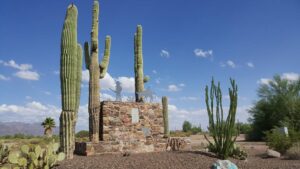
Jacob Waltz could be called the ultimate wanderlust. According to legend, he discovered a great gold mine somewhere in the hills around Apache Junction, but the precise location was lost to history after he died in 1891. A monument in Apache Junction helps keep his story and the legend of the Lost Dutchman alive.
85120
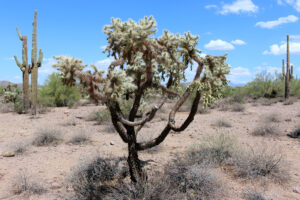
The 320-acre Lost Dutchman State Park is located near the Superstition Mountains about 40 miles east of Phoenix. The park was first developed as a day use recreation area by the Bureau of Land Management in 1972 and is named for the famed lost gold mine.
85119
Dr. Charles Bressler-Pettis conceive the idea for the Monument of States in the dark days after the attack on Pearl Harbor. Bressler-Pettis wrote to governors and asked them to send stones for a monument; they obliged. The 40-foot-tall monument is topped by a 562-pound bald eagle made of concrete and was built using stones from all 48 states (at the time of its completion). Bressler-Petti also included stones he and his wife collected from other places. The structure, dedicated in March 1943 and located at the corner of Monument Avenue and Johnston Street, contains 1,500 rocks from all 50 states and 22 countries. A number of parties, including tourists, governors, a prime minister and President Franklin D. Roosevelt, also donated stones to the cause. While it can’t be confirmed, a human skull is also alleged to be included in the mix. Interestingly some of Bressler-Petti’s ashes are said to be buried in the monument.
34741
The Granville Opera House was destroyed by fire on April 7, 1982. The historic edifice was built in 1849 as a Baptist Church and moved to a location at the corner of Broadway (Ohio Route 661) and Main Street in 1882. The church tower’s bell is still on display in a park built on the site of the Opera House. The bell first rung on June 29, 1872, to announce the death of the Reverend Samson Talbot, Denison University’s fifth president. The bell was also know for sounding on the hour and as the fire alarm.
43023
Located in downtown McRae, Ga., is a replica of the Statue of Liberty. The 35-foot-tall McRae version was built by the Lion’s Club of McRae at one-twelfth the size of the original. The statue was built using various materials, including Styrofoam, an electrician lineman’s glove and a stump from a nearby swamp. The Lady Liberty doppelgänger is located in Liberty Square, which is also home to a marble memorial honoring Telfair County residents who died in military service and a replica of the Liberty Bell, which is apparently the the town’s old fire bell was taken down (with a crack in it, of course).
31055
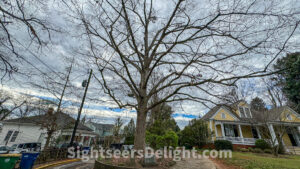
Located at the intersection of Finley and Dearing streets in Athens, Ga., The Tree that Owns Itself is an oak tree that has been willed to itself. As the story goes, in about 1890, UGA Professor William H. Jackson willed the oak tree and the land that surrounds it to the tree to protect it in perpetuity. While the original tree fell during a windstorm on Oct. 9, 1942, the oak that today stands at Finley and Dearing streets is actually an offspring of the original and is known as the Son of The Tree that Owns Itself. It was planted on Oct. 9, 1946, by the Junior Ladies Garden Club in the exact same spot.
30601
Crews building the Western & Atlantic Railroad from Atlanta to Chattanooga, Tenn., faced a number of natural obstacles. None, however, were as foreboding as Chetoogeta Mountain. What workers built was a 1,477-foot-long engineering phenomenon that has stood the test of time. Work on the tunnel started on July 15, 1848, and the first train rolled through the tunnel on May 9, 1850. The railroad actually started rail service between Atlanta and Chattanooga in the 1840s. The tunnel remained in service until 1928 when a new tunnel opened a few feet away to accommodate larger trains. For years, the older tunnel sat unused, and eventually fell into disrepair.
30755