
Guidebooks are annoying. Just because some editor who doesn’t know me tells me which restaurant is the best or what attraction is a must-see doesn’t make it a must-see attraction. Sightseers’ Delight is dedicated to the weird, the quirky and the fun. After all, traveling is fun.
If it’s not, you’re doing it wrong.
All of the places highlighted in this ever-growing database are great. Sightseers’ Delight has visited them all. We think you should make a point to see every one of them. But, this is not a guidebook. Just a webpage to help you plan your next adventure.
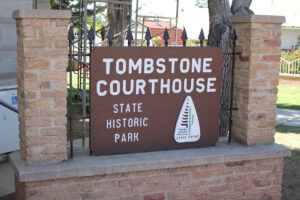
There are two versions of Tombstone. The first is the stuff of legends. The second is the real history, which while entertaining and almost unbelievable, is a little less grandiose. For anyone especially interested in learning the full story of Tombstone, a visit to the Tombstone Courthouse is an absolute must. Cochise County built the courthouse in 1882 for administrators of the then-newly created Cochise County. It remained in use until 1929, when the county seat relocated to Bisbee. After its abandonment, proprietors planned to repurpose the courthouse as a hotel, but today the courthouse houses a museum dedicated to telling the historically accurate story of Tombstone.
85638
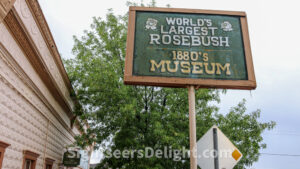
The Rose Tree Museum opened in 1964 inside a former hotel in downtown Tombstone. The museum showcases a different side of history in the mining town, one that doesn’t include a famous gunfight. But the real highlight is the World’s Largest Rose Bush. According to various sources, Mary Gee, a homesick woman from Scotland, planted the Lady Banksia rose tree in 1885. By the 1930s, the bush claimed the title of world’s largest. The building itself was the first adobe structure built in Tombstone. The Visina Mining Co. built the structure as an employee lodging house. It was later the Cochise House and the Arcade Hotel before assuming the name of Rose Tree Inn in 1935.
85635
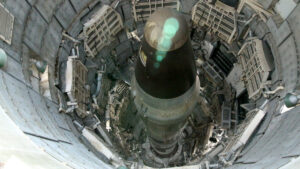
During the 1960s, the U.S. Air Force built 54 missile silos around the country, including 18 around Tucson, Ariz., to defend the country in case of attack. By the 1980s, these Titan Missile silos were obsolete, so President Reagan decommissioned them. The Titan Missile Museum opened on May 21, 1986, inside the former Titan II Missile Site 8 (571-7) in Sahuarita, Ariz., about 20 miles south of Tucson. The museum interprets life at the complex and the steps to fire the missile. The centerpiece of the museum is an inert Titan II intercontinental ballistic missile in the silo.
85614
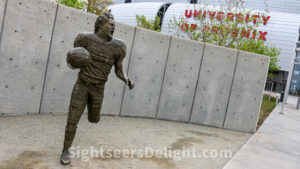
85305
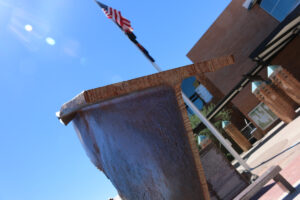
The Gilbert 9/11 Memorial features an 8-foot steel girder beam that once held up the North Tower of the World Trade Center. Gilbert Fire Chief Collin DeWitt and Assistant Fire Chief Jim Jobusch drove to New York City to personally collect the beam, then gave it the same honorable and respectful ride home they would give to a fallen soldier. Before it was installed at the memorial, the beam traveled through town so residents could see, touch and learn about it. The memorial was designed and built in four months. It also features four granite walls with the names of those lost in the attacks.
85296
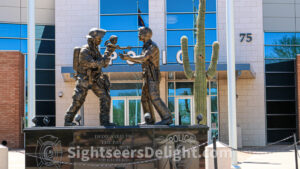
The Gilbert Public Safety Memorial was dedicated on April 30, 2007. Tempe Firefighter Steven Schneider designed the memorial. The police officer is a likeness of Rob Targosz, who was killed in the line of duty on April 30, 2006, by a drunken driver.
85296
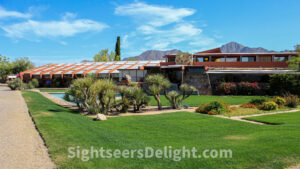
By the 1930s, when Frank Lloyd Wright and the Taliesin Fellowship began trekking west for the winter, Wright was an established architect. Taliesin West served as the winter home and school for Wright from 1937 until his death in 1959 at the age of 91. The complex drew its name from Taliesin, in Spring Green, Wisc., which served as a summer home for Wright.
85259
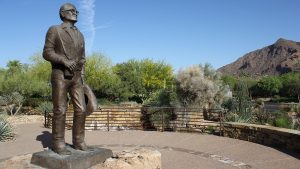
In 2004, the hometown of “Mr. Conservative” Barry Goldwater unveiled a statue of its most famous resident. Sculpted by Arizona artist Joe Beeler, the statue stands one-and-a-half times taller than Goldwater did in life. Located on a busy corner in the heart of Paradize Valley, Ariz., Goldwater’s likeness stands in the shadow of his former home. The monument is surrounded by neatly landscaped terrain featuring a plethora of local flora. An avid ham radio operator, Goldwater is perhaps best remembered for helping rekindle the conservative movement during the 1960s, publishing the acclaimed “The Conscience of a Conservative” in 1960.
85253
85250
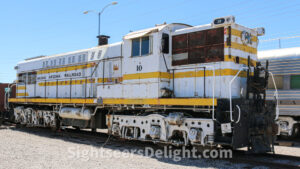
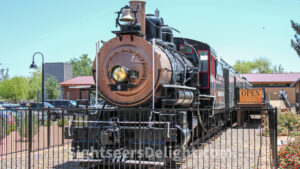
Since 1983, the Arizona Railway Museum has been dedicated to preserving and interpreting the state’s railroad history. The museum moved to its current location at the southwestern edge of Tumbleweed Park since 2006. Two items in its collection are listed in the National Register of Historic Places. They are Southern Pacific Railroad Locomotive No. SP 2562 (and Tender No. 8365) and Railroad Steam Wrecking Crane and Tool Car.
85249