
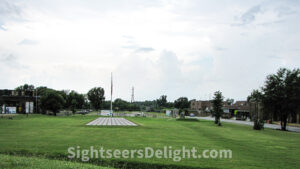
Battlefield Park commemorates the Oct. 9, 1779, Battle of Savannah during the Revolutionary War. On that day, an allied force of more than 5,000 French and American troops attacked the 2,500 British soldiers defending the city. It was the second bloodiest battle of the American Revolution, and roughly 800 troops were killed or wounded during the fight. The attack failed, and allied forces retreated from Savannah on Oct. 18, 1779; the city remained under British control until 1782. The city of Savannah purchased the land in 2003, and the park built on the site includes a modern recreation of a redoubt.
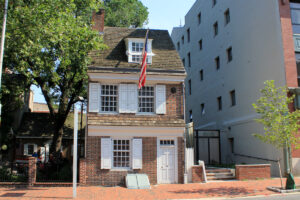
The story of Betsy Ross is one of the great American legends. As the story goes, Gen. George Washington approached Ross and asked her to make a flag. She obliged, and the rest is history. While it’s a great story, it’s most likely just a legend. Still, a visit to the Betsy Ross House is a worthy trip to learn more about Ross, a seamstress who died in 1836. The house dates to 1740 and is said to be Ross’ residence from 1776 until 1779. However, there is some debate about whether this is actually the house in which she lived.
19106
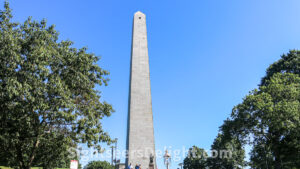
The Bunker Hill Monument was constructed to memorialize the June 17, 1775, Battle of Bunker Hill, one of the first major battles between British and Patriot forces during the American Revolution. The 221-foot-tall obelisk was erected between 1825 and 1843 in Charlestown, using granite from nearby Quincy. The Bunker Hill Museum, dedicated in June 2007, features exhibits about the battle.
02129
The Casimir Pulaski Monument stands in Monterey Square near the battlefield where Polish nobleman Casimir Pulaski died during the siege of Savannah. Pulaski, along with Michael Kovats de Fabriczy, is considered “the father of the American cavalry.” Workers laid the cornerstone for the monument in either 1825 or 1853, depending on the source. The monument’s inscription reads, “Pulaski, the Heroic Pole, who fell mortally wounded, fighting for American Liberty at the siege of Savannah, October 9, 1779.” On October 29, 1779, Congress passed a resolution that a monument should be dedicated to Pulaski, and the Savannah monument was the first monument in the United States dedicated to Pulaski.
City Tavern in Philadelphia was one of the city’s best-known gathering places during the Revolutionary era, serving as a hub for travelers, merchants and political leaders from 1774 to about 1800. The original building quickly gained a reputation as an important social and civic center, with meals, lodging and business conducted there and weekly balls held on the second floor. John Adams called it “the most genteel tavern in America,” a sign of the tavern’s standing in colonial Philadelphia.
Built after the land was conveyed in 1772 and completed by subscription, City Tavern became closely associated with the Founding Fathers and the politics of the Revolution. More than 200 men gathered there in May 1774 to respond to Boston’s call for support after the Boston Port Bill, and the site later hosted other notable moments, including an early Fourth of July celebration in 1777. George Washington also met the Marquis de Lafayette there for the first time that year.
The original building was damaged by fire in 1834 and later demolished. The structure standing today is a late-20th-century reconstruction built for the 1976 Bicentennial, preserving the memory of one of Revolutionary Philadelphia’s most important public gathering places.
19106
Copp’s Hill Burying Ground in the North End of Boston was established on Feb. 20, 1659, as North Burying Ground and is the second oldest cemetery in the city. The hill is named for William Copp, a shoemaker who once owned the land. Among those buried in the graveyard is Robert Newman, the patriot who placed the lanterns in the steeple of Old North Church for Paul Revere’s midnight ride.
02113
Faneuil Hall, a meeting hall and marketplace since 1743, is best known as the site of speeches by Samuel Adams and others. The historic building, often called “the Cradle of Liberty,” is part of Boston National Historical Park and a favorite stop on the Freedom Trail. Peter Faneuil, a wealthy merchant, slave trader and philanthropist built Faneuil Hall and donated the edifice to Boston.
02109
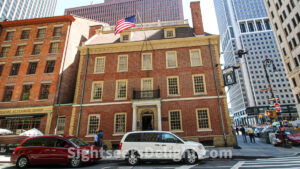
The historic Fraunces Tavern played a prominent role before, during and after the American Revolution. The edifice was a headquarters for George Washington, a venue for peace negotiations with the British and housed federal offices during the early days of the republic. Downstairs is a tavern, and a museum is located upstairs. Exhibits include a lock of hair and a tooth from George Washington.
10004
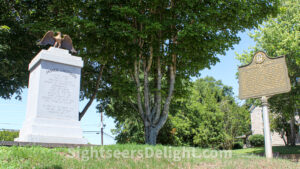
The James Jackson Memorial in downtown Jefferson, Georgia, honors an American Revolution hero and general of the Georgia Militia. He is also the namesake of Jackson County, Georgia. Jackson served in the U.S. House of Representatives and the U.S. Senate. He also served as the 23rd Governor of Georgia from 1798 to 1801. The Jackson County Bicentennial Committee dedicated the monument, which is on the grounds of the Historic Jackson County Courthouse, on May 11, 1996.
30549
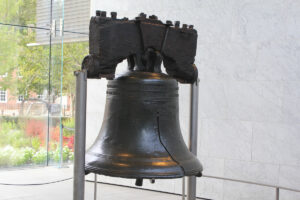
Of all the nation’s symbols, none may be as enduring as the Liberty Bell. A Philadelphia institution for two-and-a-half centuries, the bell’s story is as much fiction and folklore as it is a fact. Initially cast in 1752 by the Whitechapel Bell Foundry, a British foundry still in operation today, the bell arrived in Philadelphia in August 1752, cracked on its first use. A pair of founders, John Pass and John Stow, offered to recast the bell. Even though neither was an expert in bell casting, the two broke up the bell, melted it down and recast it after adding copper to the mix to strengthen the metal. What emerged was the Liberty Bell.