
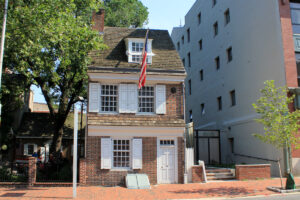
The story of Betsy Ross is one of the great American legends. As the story goes, Gen. George Washington approached Ross and asked her to make a flag. She obliged, and the rest is history. While it’s a great story, it’s most likely just a legend. Still, a visit to the Betsy Ross House is a worthy trip to learn more about Ross, a seamstress who died in 1836. The house dates to 1740 and is said to be Ross’ residence from 1776 until 1779. However, there is some debate about whether this is actually the house in which she lived.
19106
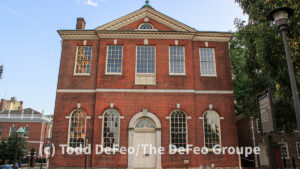
Carpenters’ Hall in Philadelphia is best known as the site of the First Continental Congress in 1774, when delegates from the colonies met to respond to growing tensions with Britain. Built in 1770 for the Carpenters’ Company of Philadelphia, the hall served as the meeting place for Congress from Sept. 5 to Oct. 26, 1774. During that session, colonial leaders openly stated their grievances and agreed on a policy of resistance, making the building one of the key early settings in the movement toward American independence.
The two-story structure was built for a society of master craftsmen modeled after England’s guild traditions. In addition to its political importance, Carpenters’ Hall was also associated with Benjamin Franklin’s Library Company. After Congress moved elsewhere, the building continued to serve a range of public uses. During the Revolutionary War, the lower floor functioned as a hospital, while arms and equipment were stored in the basement.
In the early national period, the building was rented for additional civic purposes, including use by Secretary of War Henry Knox and, in 1791, the first Bank of the United States. Preserved and restored over time, it remains one of Philadelphia’s most important historic buildings.
19106
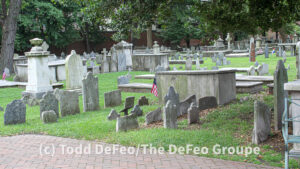
Christ Church Burial Ground at 5th and Arch Streets in Philadelphia is the final resting place for several signers of the Declaration of Independence, including Benjamin Franklin and his wife, Deborah. Other signers buried in the cemetery are Joseph Hewes, Francis Hopkinson, George Ross and Benjamin Rush. Christ Church, an Episcopal church founded in 1695 and a place of worship for many of the famous Revolutionary War participants, including George Washington, owns the cemetery. The cemetery, located across from the Visitors Center and National Constitution Center, began in 1719.
19106
City Tavern in Philadelphia was one of the city’s best-known gathering places during the Revolutionary era, serving as a hub for travelers, merchants and political leaders from 1774 to about 1800. The original building quickly gained a reputation as an important social and civic center, with meals, lodging and business conducted there and weekly balls held on the second floor. John Adams called it “the most genteel tavern in America,” a sign of the tavern’s standing in colonial Philadelphia.
Built after the land was conveyed in 1772 and completed by subscription, City Tavern became closely associated with the Founding Fathers and the politics of the Revolution. More than 200 men gathered there in May 1774 to respond to Boston’s call for support after the Boston Port Bill, and the site later hosted other notable moments, including an early Fourth of July celebration in 1777. George Washington also met the Marquis de Lafayette there for the first time that year.
The original building was damaged by fire in 1834 and later demolished. The structure standing today is a late-20th-century reconstruction built for the 1976 Bicentennial, preserving the memory of one of Revolutionary Philadelphia’s most important public gathering places.
19106
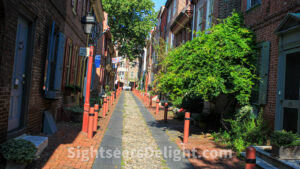
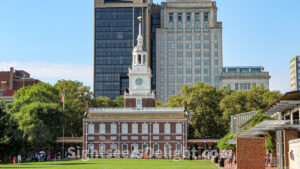
Independence Hall, the centerpiece of Independence National Historical Park, is where the Founding Fathers signed the Declaration of Independence in 1776. Inside the building nearly a dozen years later, in 1787, they laid the framework for the U.S. Constitution. Today, the historic edifice is the centerpiece of Independence National Historical Park. A guided tour of the building brings to life the many events that happened inside the building’s four walls that shaped the country’s early history.
19106
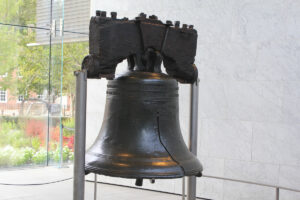
Of all the nation’s symbols, none may be as enduring as the Liberty Bell. A Philadelphia institution for two-and-a-half centuries, the bell’s story is as much fiction and folklore as it is a fact. Initially cast in 1752 by the Whitechapel Bell Foundry, a British foundry still in operation today, the bell arrived in Philadelphia in August 1752, cracked on its first use. A pair of founders, John Pass and John Stow, offered to recast the bell. Even though neither was an expert in bell casting, the two broke up the bell, melted it down and recast it after adding copper to the mix to strengthen the metal. What emerged was the Liberty Bell.
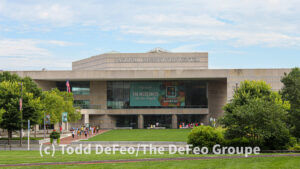
The private, nonprofit National Constitution Center brings people together to learn about, debate and celebrate arguably the most important document ever created: the U.S. Constitution. The center, located on Independence Mall, is an interactive museum that is a hub for conversation and study of the Constitution. Its congressional charter “to disseminate information about the U.S. Constitution on a nonpartisan basis.”
19106
19107
19130