
Guidebooks are annoying. Just because some editor who doesn’t know me tells me which restaurant is the best or what attraction is a must-see doesn’t make it a must-see attraction. Sightseers’ Delight is dedicated to the weird, the quirky and the fun. After all, traveling is fun.
If it’s not, you’re doing it wrong.
All of the places highlighted in this ever-growing database are great. Sightseers’ Delight has visited them all. We think you should make a point to see every one of them. But, this is not a guidebook. Just a webpage to help you plan your next adventure.
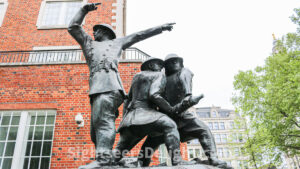
The National Firefighters Memorial of three bronze statues showing firefighters in action is a tribute to the brave men and women who fought fires during the Blitz in London. The memorial, located on the Jubilee Walkway near St. Paul’s Cathedral, was created to honor the firefighters who fought fires on the streets of London during World War II and to commemorate the service of firefighters throughout the war. Cyril Demarne conceived the idea for the memorial, which was commissioned by the Firefighters Memorial Charitable Trust in 1990. Sculpted by John W. Mills, the monument was unveiled by Queen Elizabeth The Queen Mother on May 4, 1991. In 1998, it was decided to make the memorial a national monument to honor all firefighters in the United Kingdom who lost their lives while on duty, not just during World War II. As a result, the monument was moved from its original location in Old Change Court, the plinth was raised by more than one meter, and the names of all firefighters who died in peacetime were added.
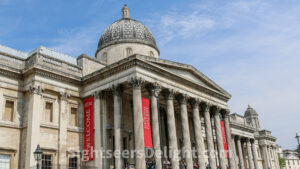
The National Gallery dates to 1824 when the British government bought 38 paintings from the heirs of John Julius Angerstein, a London businessman. Today, the museum, located in Trafalgar Square, is home to more than 2,300 works of art, some dating to the mid-13th century. Some critics point out the museum’s collection is smaller when compared to other European national galleries.
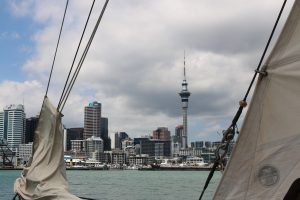
The National Maritime Museum celebrates New Zealand’s seafaring history from the voyaging traditions of the Pacific peoples to early European arrivals and modern ocean racing. In Māori, the museum name is Te Huiteananui-a-Tangaroa, the legendary house belonging to Tangaroa, Māori god of the sea. Galleries tell the story of peoples whose lives were forever linked to the sea. Along the way, try your hand at yacht design, relax in a Kiwi style bach, hear the cannon fire and test your sea legs in the rocking cabin. Don’t miss the opportunity to get out on the water aboard one of the museum’s fully restored heritage fleet.
Based on content courtesy of Tourism New Zealand.
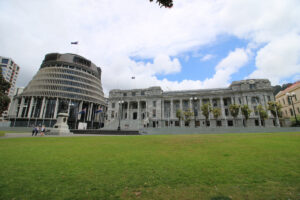
New Zealand Parliament is comprised of a series of buildings, including the recognizable Beehive. The complex also includes the Edwardian neoclassical-style Parliament House, which dates to 1922. For anyone interested in learning more about the New Zealand Parliament, visitors can take a tour of the complex. Tour guides offer a history of the legislative body and bring visitors to committee rooms and the floor of parliament.
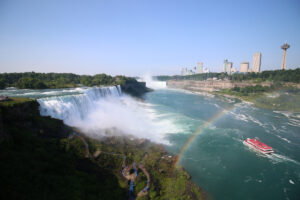
Niagara Falls is the name of a trio of waterfalls (Horseshoe Falls, the American Falls and the Bridal Veil Falls) straddling the border of the United States and Canada in upstate New York and southern Ontario. The falls formed roughly 10,000 years ago during the Wisconsinan glaciation, the North American ice sheet complex’s most recent glacial period. More than 20 million people visit Niagara Falls every year. The best-known tourist attraction at the falls is the Maid of the Mist, named for an ancient Ongiara Indian mythical character. The boat has transported passengers into the rapids immediately below the falls since 1846.
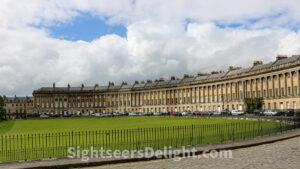
A famous semicircle row of Georgian townhouses was built based on designs by architect John Wood the Younger between 1767 and 1774. One of the houses, the No. 1 Royal Crescent, has been preserved as a museum, giving visitors a window into 18th century life. Complete with authentic furniture and artifacts, each room tells a story of daily life 300 years ago. In one of the rooms, the Gentlemen’s Retreat, visitors can learn more about Henry Sandford, the townhouse’s first resident who lived here from 1776 until 1796.
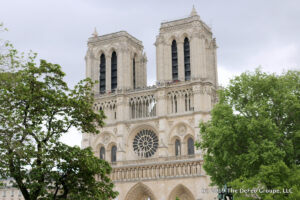
Workers began construction on Notre-Dame de Paris, which means “Our Lady of Paris,” in 1163. The famous Catholic cathedral, completed in 1345, is considered to be one of the best examples of French Gothic architecture in the world, not to mention its status as one of the world’s most famous churches. The cathedral served as the backdrop of Victor Hugo’s 1831 novel, “The Hunchback of Notre-Dame.” A fire on April 15, 2019, heavily damaged the cathedral, but officials have vowed to rebuild the structure.
From the days of bartering for goods to today’s currency and modern system of banking, the Numismatic Museum takes a look at money on the island. This delightful museum, owned and operated by the Bank of the Netherlands Antilles, is conveniently located in the Scharloo section of Willemstad and a short walk from popular attractions such as the Queen Emma Bridge.
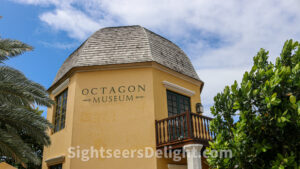
Simón Bolívar’s two sisters lived in this octagonal building while Bolívar worked in a house on a hill overlooking Willemstad’s harbor. The Curacao Monument Foundation and the Avila Beach Hotel restored the building, which is today part of the hotel. The building is home to a museum highlighting Curacao’s connection to Simón Bolívar.