
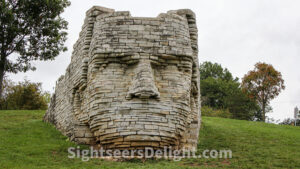
Leatherlips is one of Ohio’s great historic legends. He was executed in on June 1, 1810, though the precise location is open to some debate. To honor the great Wyandot Native American Chief, the Dublin, Ohio, community in 1990 unveiled a 12-foot high sculpture of Leatherlips’ head. Designed by Boston artist Ralph Helmick and located in Scioto Park, the portrait was made using stacked native limestone. The top is open with stacked stones extending back along its sides, making for a popular picture stop.
43065
Located along the historic Ohio & Erie Canal, Lock 2 is one of roughly 20 locks that once lifted and lowered canal boats through the center of Akron. The lock played a vital role in the 19th-century canal system that linked Akron to Lake Erie in Cleveland and later to the Ohio River near Portsmouth, creating important trade routes that helped the region rapidly grow. Today, Lock 2 is easily accessible along the scenic Towpath Trail, positioned between Akron Children’s Hospital and Canal Park Stadium.
44308
The Matthews Hotel Monument, located at North Howard Street and Martin Luther King Jr. Boulevard, honors one of Akron’s most important cultural landmarks. From the 1930s through the 1950s, the Matthews Hotel welcomed legendary jazz musicians who performed in the city while traveling between major gigs in New York and Chicago. Icons such as Cab Calloway, Louis Armstrong, Count Basie and Ella Fitzgerald stayed here during an era when segregation prevented Black performers from lodging in white-only downtown hotels. The original hotel was demolished in 1982. Akron artist Miller Horns, who passed away in 2012, dedicated his life to ensuring its legacy lived on. Construction of the monument began in 2011 with support from local contractors who donated labor and materials.
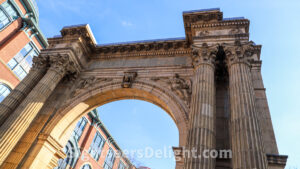
McFerson Commons is a 2.2-acre park in Columbus’ Arena District. McFerson Commons was previously named Arena Park. The park’s centerpiece is the Union Station arch. Daniel Burnham & Co. designed Union Station. The arch was salvaged before the demolition of the station in the 1970s.
43215
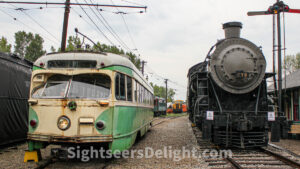
Founded in 1948 and incorporated in 1950, the Ohio Railway Museum is among the oldest railroad museums in the country. The museum operates over the former Columbus, Delaware, and Marion Railway right-of-way. One of its key locomotives on display is Norfolk & Western No. 578, an American Locomotive Co. 4-6-2 “Pacific” E2a steam locomotive. Built in March 1910, the steamer is said to be one of the last surviving E2a locomotives built for the Norfolk and Western Railway Co.
43085

Construction on the Ohio Statehouse started in 1839, and the structure was completed in 1861 and is considered to be a significant architectural accomplishment. The edifice, the seat of Ohio’s government, has been restored to its 1861 appearance. To learn more about the Buckeye State can venture to the Ohio Statehouse Museum Education Center on the ground floor of the statehouse. Visitors can participate in a tour or wander the museum at their own pace. A monument to President William McKinley, a native of Niles, Ohio, stands in front of the statehouse.
43215
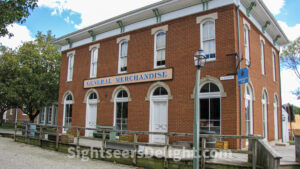
The Ohio Historical Society operates the Ohio Village living history museum. The 15-acre museum, which opened on July 27, 1974, aims to give a firsthand view of life in Ohio during the Civil War. The village is home to 22 buildings, including a mix of reproductions and historic structures relocated to the site.
43211
The Old Colony Burying Ground was established in 1805 and is the final resting place of many early Granville pioneers. The first burial was in 1806, and the oldest surviving gravestone is dated 1808. It is the resting place for veterans from the Revolutionary War, War of 1812, and Civil War, along with ministers, farmers, industrialists, physicians, mothers, children, and other citizens of Granville.
43023
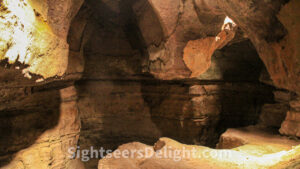
The Olentangy Indian Caverns, located in Delaware, Ohio, north of Columbus, are a series of natural underground caves formed millions of years ago by an underground river that cut through the limestone rock. The cave’s passages and rooms occupying three different levels. According to the caverns’ webpage, Wyandots used the caverns over the years as a place of refuge from both their enemies (the Delaware Indians) and the weather.
43015
The Granville Opera House was destroyed by fire on April 7, 1982. The historic edifice was built in 1849 as a Baptist Church and moved to a location at the corner of Broadway (Ohio Route 661) and Main Street in 1882. The church tower’s bell is still on display in a park built on the site of the Opera House. The bell first rung on June 29, 1872, to announce the death of the Reverend Samson Talbot, Denison University’s fifth president. The bell was also know for sounding on the hour and as the fire alarm.
43023