
Guidebooks are annoying. Just because some editor who doesn’t know me tells me which restaurant is the best or what attraction is a must-see doesn’t make it a must-see attraction. Sightseers’ Delight is dedicated to the weird, the quirky and the fun. After all, traveling is fun.
If it’s not, you’re doing it wrong.
All of the places highlighted in this ever-growing database are great. Sightseers’ Delight has visited them all. We think you should make a point to see every one of them. But, this is not a guidebook. Just a webpage to help you plan your next adventure.
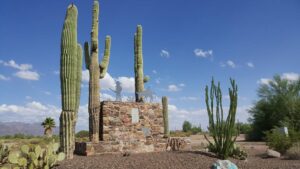
Jacob Waltz could be called the ultimate wanderlust. According to legend, he discovered a great gold mine somewhere in the hills around Apache Junction, but the precise location was lost to history after he died in 1891. A monument in Apache Junction helps keep his story and the legend of the Lost Dutchman alive.
85120
The 320-acre Lost Dutchman State Park is located near the Superstition Mountains about 40 miles east of Phoenix. The park was first developed as a day use recreation area by the Bureau of Land Management in 1972 and is named for the famed lost gold mine.
85119
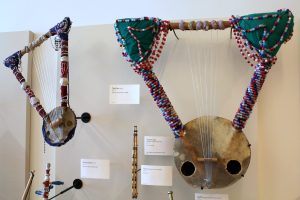
This 200,000-square-foot, $250 million museum museum opened in April 2010. Its collection is astounding, bringing together more than 15,000 instruments from 200-plus countries under one roof. But, these are not just static displays. To bring the instruments to life, the museum uses a combination of wireless technology and high-resolution videos. When a museum guest approaches a video screen, they can listen to and watch the instruments in action, played by true artisans who can bring them to life.
85050
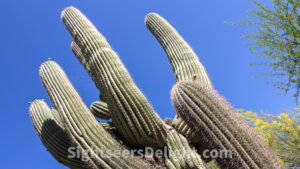
The 140-acre Desert Botanical Garden was established in 1939 and is home to more than 21,000 flowers. Plants are on display along five thematic trails that cover a range of topics, including conservation, desert living and people of the Sonoran Desert.
85008
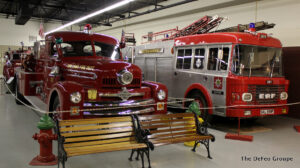
The National Historical Fire Foundation is better know as the Hall of Flame. The museum is dedicated to preserving firefighting equipment used in Arizona and around the world. The museum has five exhibit bays and the National Firefighting Hall of Heroes gallery. The equipment is grouped as: Hand & Horse Drawn (1725–1908); Motorized Apparatus (1897–1948); Motorized Apparatus (1918–1968); Motorized Apparatus (1919–1950) and Wildland Firefighting. It has also have a large collection of Fire Department arm patches.
85008
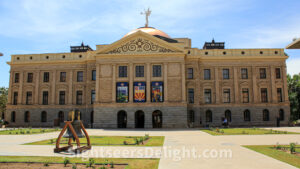
Inside the Arizona State Capitol building, which was built in 1901 and predates Arizona’s 1912 entry into the Union as a state, the story of The Grand Canyon State comes to life. Displays include the silver and copper punchbowl service from the USS Arizona, said to be the only one of its kind. it is composed of etched copper panels depicting desert scenes set into a silver bowl ornamented with mermaids, dolphins, waves, and other nautical themes. In addition, the museum also displays a collection of gifts received by Arizona as part of the Merci Train sent by France to the United States following World War II. Outside, the Wesley Bolin Memorial Plaza on the Phoenix state capitol grounds are filled with an impressive collection of monuments, including one to the Navajo Code Talkers of World War II.
85007
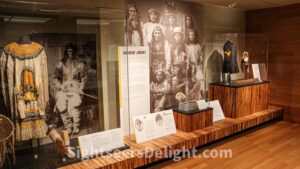
The story of Arizona would be far from complete without the Native American perspective. While it is at times a difficult story to tell and a difficult story to hear, the Heard Museum does a magnificent job brining the Native American Experience to life. Dwight B. and Maie Bartlett Heard founded the museum in 1929 to house their personal art collection. Today, the 130,000-square-foot museum features more than 40,000 items in its collection, including the Barry Goldwater collection of Hopi kachina dolls.
85004
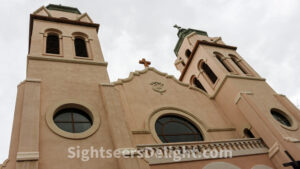
The Church of the Immaculate Conception of the Blessed Virgin Mary, also called St. Mary’s Basilica, is the oldest Catholic parish and the second oldest church in Phoenix. Between 1872 and 1881, Catholic priests from Florence, Arizona, would travel by buggy every three months to perform the liturgy. The building was constructed between 1902 and 1914, blending the Mission Revival and Spanish Colonial Revival architectural styles. It was officially dedicated in 1915 and replaced an earlier adobe church built in 1881 when the parish was founded. Starting in 1895, Franciscan Friars staffed the parish. Until 1924, it was the only Catholic parish in Phoenix. On September 6, 1976, the Arizona Historical Society named St. Mary’s an historic site. About a decade later, in 1985, Pope John Paul II elevated the church to a minor basilica.
85004
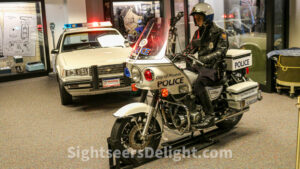
The Museum traces its origins to October 1993. The original small museum in the city’s historic city hall has today blossomed to a more robust museum located in the same building. Open to the public without charge, the museum features a number of exhibits that interpret the city’s law enforcement history. One of the more unique exhibits is the jail rock with leg shackles attached to it. Dating to the 1860s, the jail rock was used to detain lawbreakers in the days before the city had a proper jail. Another particularly poignant display is the Memorial Room. The memorial honors the Phoenix police officers killed in the line of duty.
85003
While many know the Harry Ransom Center as an internationally renowned humanities research center, it hosts many exhibits of interest to the general traveling public. The center, located at The University of Texas at Austin, is home to 100,000 works of art, 5 million photographs, more than 42 million manuscripts and nearly 1 million books. The collection’s highlights include one of only 20 complete copies of the Gutenberg Bible in the world.
78712