
Guidebooks are annoying. Just because some editor who doesn’t know me tells me which restaurant is the best or what attraction is a must-see doesn’t make it a must-see attraction. Sightseers’ Delight is dedicated to the weird, the quirky and the fun. After all, traveling is fun.
If it’s not, you’re doing it wrong.
All of the places highlighted in this ever-growing database are great. Sightseers’ Delight has visited them all. We think you should make a point to see every one of them. But, this is not a guidebook. Just a webpage to help you plan your next adventure.
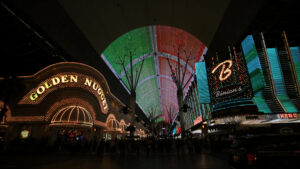
Fremont Street Experience is a five-block entertainment district located in historic downtown Las Vegas. It is home to North America’s largest video screen, measuring 1,500 feet long, 90 feet wide and suspended 90 feet above the urban pedestrian mall. The zone is also home to a trio of states for free nightly concerts and SlotZilla, an 850-foot long Zipline and a 1,750-foot long Zoomline that launch riders from a 12-story slot-machine themed takeoff platform.
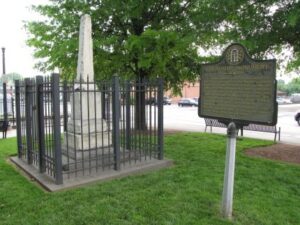
When Mark Anthony Cooper found himself $100,000 in debt in 1857 and his company, the Etowah Iron and Manufacturing Co., was about to be auctioned, he turned to his friends for help. With the help of 38 friends, Cooper raised $200,000 and purchased back his company. But, he didn’t forget his friends, and in 1860, after he repaid the debt, Cooper built a monument to thank them. The monument was originally erected on the town square of Etowah where his iron company was located. In 1864, the monument survived the wrath of Union soldiers led by Gen. William T. Sherman. In 1927, as the federal government was poised to create Lake Allatoona, the monument was relocated to nearby Cartersville. Three decades later, the monument was moved to the banks of Lake Allatoona to make room for more parking spaces in downtown Cartersville. In 1999, the monument moved to its current location in downtown Cartersville and the aptly renamed Friendship Plaza.
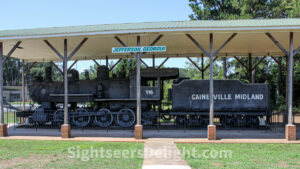
Philadelphia-based Baldwin Locomotive Works built Gainesville Midland No. 116, which sits in Jefferson, Georgia, as a memorial to the Gainesville Midland Railroad. The Gainesville Midland bought the class C-3 2-8-0 locomotive from the Central of Georgia Railway, which ordered it in about 1906. The Gainesville Midland used the steamer until its retirement in 1958 following a crack in its boiler. The locomotive is on display outside of Jefferson High School. The railroad donated it to the city in 1959.
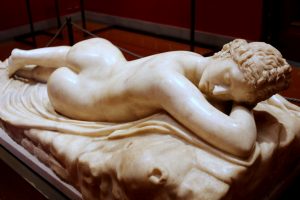
Galleria degli Uffizi is arguably the most famous art museum in the world. It makes sense considering Florence is the birthplace of the Renaissance in the 14th century. The museum is located in the Historic Centre of Florence and opened as a museum in 1769. Among its famous works of art is Sandro Botticelli’s 15th century “Birth of Venus.” It also houses works by Michelangelo, Raphael and Leonardo da Vinci.
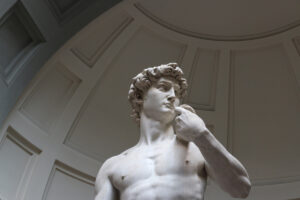
The Galleria dell’Accademia di Firenze (Gallery of the Academy of Florence) is home to Michelangelo’s famed David statue and is the second most visited art museum in Italy. The museum dates to 1784 and has been home to the David sculpture since 1873. In addition to its most famous work of art, the museum houses paintings by Florentine artists, many from 1300-1600.
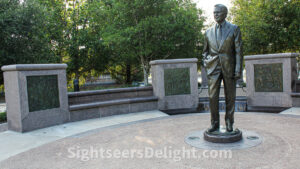
The George H. W. Bush Monument in Houston, Texas, was unveiled in December 2004 and features an eight-foot-tall bronze statue of George H. W. Bush. Chas Fagan designed the monument, located in Houston’s Sesquicentennial Park and part of a larger project that included a plaza and a wall with four reliefs sculpted by Willy Wang that highlight events of Bush’s career. David B. Jones and local immigration lawyer Charles Foster led the private funding for the project, which cost $1.7 million.
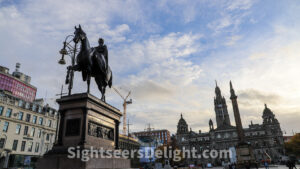
George Square in Glasgow is an iconic central city square. It has been the backdrop of many historical moments, including a 1940s film set. Today, George Square is known as the principal civic square in Glasgow, named after King George III. It was laid out in 1781 and is home to Glasgow City Council’s headquarters. The square is home to several statues and monuments, including likenesses of famous Scots such as Robert Burns, James Watt, Sir Robert Peel and Sir Walter Scott.
Giardino di Boboli or the Boboli Gardens is a vast garden located behind the Pitti Palace. It features a collection of Roman antiquities and sculptures from the 16th through the 18th centuries. The Boboli Gardens were laid out for the wife of Cosimo I de’ Medici, Eleonora di Toledo.
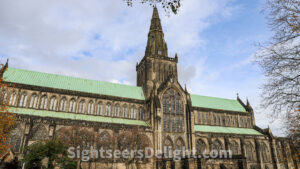
Glasgow Cathedral, known as Cathair-eaglais Ghlaschu in Scottish Gaelic, is a historic parish church in Glasgow, Scotland, that belongs to the Church of Scotland. It is considered the oldest cathedral in mainland Scotland and the oldest building in Glasgow. The cathedral was once the seat of the Archbishop of Glasgow and, until the Scottish Reformation in the 16th century, it served as the mother church of the Archdiocese of Glasgow and the Province of Glasgow. The Bishop’s Castle, built in medieval times, once stood west of the cathedral until the 18th century. Saint Mungo, the patron saint of Glasgow, is honored at the cathedral, and his tomb lies in the Lower Church at the center of the building. The first stone cathedral was dedicated to Saint Mungo in 1136 in the presence of David I, and fragments of this structure have been found beneath the current cathedral, which was dedicated in 1197. The cathedral underwent significant rebuilding in the 13th century, and the University of Glasgow held its first classes in the cathedral’s chapter house after it was founded in 1451. Following the Reformation, the cathedral was partitioned to accommodate three separate congregations. However, in the early 19th century, there was a growing appreciation for the cathedral’s medieval architecture. Glasgow Cathedral has been Crown property since 1587 and under the state’s care since 1857. Today, it is the responsibility of Historic Environment Scotland, and the congregation is part of the Church of Scotland’s Presbytery of Glasgow.