
Guidebooks are annoying. Just because some editor who doesn’t know me tells me which restaurant is the best or what attraction is a must-see doesn’t make it a must-see attraction. Sightseers’ Delight is dedicated to the weird, the quirky and the fun. After all, traveling is fun.
If it’s not, you’re doing it wrong.
All of the places highlighted in this ever-growing database are great. Sightseers’ Delight has visited them all. We think you should make a point to see every one of them. But, this is not a guidebook. Just a webpage to help you plan your next adventure.
Opened in January 2009, Tellus is home to one of only two digital planetariums in Georgia. The 120,000-square-foot museum also includes Science in Motion, a journey through the development of motorized transportation. Tellus replaced the Weinman Mineral Museum, a 9,000-square-foot museum.
30120
Just south of Adairsville, the raiders stopped to tear up the track, prohibiting their pursuers from continuing the chase in a locomotive. At this point, the pursuers abandoned their second locomotive — the William R. Smith — and continued on foot. Minutes later, they commandeered their third engine. They ran the Texas in reverse for the remainder of the chase. Today, a small museum located in the historic 1847 Western & Atlantic depot interprets the city’s role in the Great Locomotive Chase and features a number of exhibits related to the town’s history.
30103
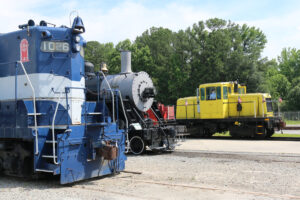
The 35-acre Southeastern Railway Museum opened in its current location in 1998. The museum, which previously operated on a 12-acre site until 1997, is home to approximately 90 pieces of rolling stock, including locomotives, passenger cars and cabooses. Guests can board a vintage caboose for a ride around the museum’s grounds, which was previously home to a railcar repair facility. The museum has been designated “Georgia’s Official Transportation History Museum.”
30096
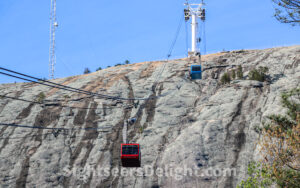
Make the 1.3 mile trek or ride the sky lift up Stone Mountain. With more than 3,300 acres of natural beauty, a variety of outdoor attractions, entertainment and recreation, Stone Mountain is the most visited attraction in Georgia. Visitors can now climb to new heights on Sky Hike, a quarter of a mile course that allows visitors to trek through the treetops by mastering wooden bridges, balancing on a single rope suspended in the air and climbing to the top of vertical net bridges.
30083
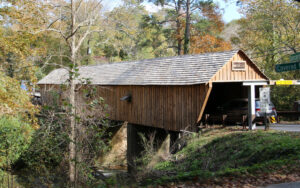
The Concord Covered Bridge over Nickajack Creek was built in 1872 to replace an earlier bridge destroyed during the Civil War. The one-lane bridge, also known as Nickajack Creek Covered Bridge, is more than 130 feet long and 16 feet wide and is a part of the Covered Bridge Historic District, so named for the bridge. An earlier bridge was built in the area in 1848, but troops under Union Gen. William T. Sherman burned the span on July 4, 1864. The current bridge was renovated or upgraded in the 1950s and again in 1999. Much of the traffic that used to cross the bridge was diverted to the East-West Connector when it opened in the 1990s. The one-lane bridge has a relatively low clearance, and several times every year motorists driving vehicles too big for the bridge crash into the structure and damage it.
30082
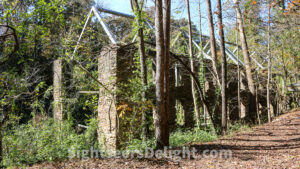
Concord Woolen Mills dates to 1847 when Robert Daniell and Martin Ruff opened the mill. The mill was destroyed on July 4, 1864, by Union Gen. William T. Sherman’s troops. The two men rebuilt the mill, which reopened in 1868. By 1870, the mill had 16 workers, making it the largest employer in the area. The two men sold the mill in 1872. The mill went out of business in 1916, and the ruins are located along what is today the Heritage Park Trail and Silver Comet Trail.
30082
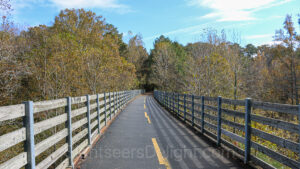
The Silver Comet Trail repurposed a former rail line into a popular multi-purpose path. The route dates to the 1890s when a rail line connecting Atlanta and Birmingham, Ala. Seaboard Air Line Railroad operated the line and its successor, CSX, abandoned it in 1987. The trail is named for the Silver Comet passenger train, which ran from May 18, 1947, until 1969. The trail starts in Smyrna, Ga., and passes through Paulding and Polk counties and connects with the Chief Ladiga Trail at the Georgia-Alabama border.
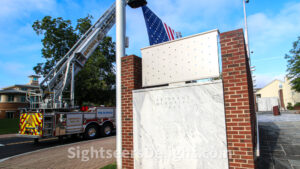
The 20th Century Veterans Memorial in downtown Smyrna, Georgia, was dedicated on October 12, 2002. A Veterans Memorial Committee chose the site for the monument in August 1999, and it was expected to be finished by Labor Day 2001 at a cost of between $1 million and $1.5 million. In March 2000, the Smyrna City Council and the Smyrna Downtown Development Authority signed off on the plan despite opposition from nearby residents. However, work was delayed about a year, and officials broke ground on the project in January 2002. Then-Gov. Roy Barnes, U.S. Rep. Johnny Isakson and U.S. Sen. Max Cleland were among the dignitaries at the memorial’s dedication. A mix of private and state money funded the $650,000 memorial.
30080
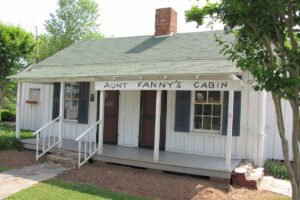
IN 2022, THE CITY OF SMYRNA DEMOLISHED AUNT FANNY’S CABIN.
The building that today serves as the Smyrna Welcome Center was once a famous restaurant serving up Southern-themed fare. Isoline Campbell MacKenna opened Aunt Fanny’s Cabin in 1941, turning an 1890s-era cabin into a country store selling food made using the recipes of Fanny Williams, her family’s retired cook. The restaurant, originally located a few miles away from its current location operated until 1994.
30080
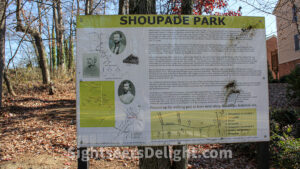
Shoupade Park preserves a rare but essential remnant of the Civil War’s River Line. Confederate Brigadier Gen. Francis Shoup in 1864 built a series of earthen forts shaped like arrowheads large enough to hold 80 soldiers. The fortification, known as “Shoupades,” allowed them to fire shots to the right, left and straight ahead as the enemy approached. Confederate troops wanted the shoupades to stop Union troops from crossing the Chattahoochee River and entering Atlanta. Modern development wiped out most of the Shoupades over the years. However, through an agreement with a developer, the city of Smyrna helped preserve one of the works. A shoupade model is on display at the Smyrna Museum.
30080