
Guidebooks are annoying. Just because some editor who doesn’t know me tells me which restaurant is the best or what attraction is a must-see doesn’t make it a must-see attraction. Sightseers’ Delight is dedicated to the weird, the quirky and the fun. After all, traveling is fun.
If it’s not, you’re doing it wrong.
All of the places highlighted in this ever-growing database are great. Sightseers’ Delight has visited them all. We think you should make a point to see every one of them. But, this is not a guidebook. Just a webpage to help you plan your next adventure.
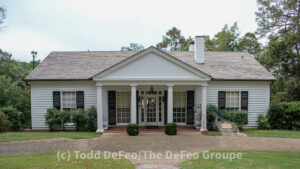
The Little White House, now a National Historic Landmark, was built by Franklin Delano Roosevelt in 1932 while he served as governor of New York, before his inauguration as president in 1933. He first visited Warm Springs in 1924 in search of a cure for the infantile paralysis (polio) that had affected him in 1921. Although swimming in the 88-degree, buoyant spring waters did not provide a miraculous cure, it did lead to some improvement in his condition. During his presidency and the Great Depression, FDR developed many New Deal programs, including the Rural Electrification Administration, based on his experiences in this small town.
31830
The Crime and Punishment Museum in Ashburn, Georgia, opened in August 2003 in a bucolic community of about 4,100 located along Interstate 75. The building — known to many as “Castle Turner” — served as the county jail from about 1907 until 1993. Miles Cribb was the only inmate hanged inside the jail. Today, visitors to the museum can see the trap door that dropped, sending the condemned Cribb to his death. They can also gaze upon the blood-stained collar he was wearing at the time he was executed and see a replica of an electric chair, affectionately nicknamed “Old Sparky.”
31714
31709
James Oglethorpe established Fort Frederica on what is today St. Simons Island in 1736, just three years after he founded Georgia.. The goal of the settlement was to to protect the southern boundary of the British colony of Georgia from the Spanish. At times, more than 600 British troops were stationed at the fort. A visitor to the fort in 1745 described it as “a pretty strong fort of tabby,” noting the structure was “surrounded by a quadrangular rampart, with four bastions of earth well stocked and turned, and a palisade ditch.” During the battles of Bloody Marsh and Gully Hole Creek in 1742, Oglethorpe’s successfully repulsed Spanish attempts to invade St. Simons Island.
31522
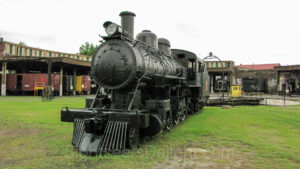
The Georgia State Railroad Museum is home to more than 40 railroad locomotives and cars and house in the historic Georgia State Railroad Museum roundhouse. The building dates to 1851, but the railroad demolished about half of the roundhouse in 1926 and re-engineered the facility to accommodate larger steam engines. Southern Railway, successor of the Central of Georgia Railroad, closed the facility in 1963 and subsequently started demolishing buildings on the property. The Coastal Heritage Society in 1989 took over management of the facility to preserve the shops for future generations.
31401
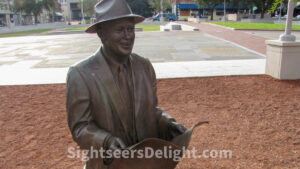
Savannah honors hometown legend Johnny Mercer, one of America’s greatest songwriters, with a life-size bronze unveiled on Nov. 18, 2009, the centennial of his birth. Mercer penned more than 1,500 songs across a five-decade career; “Moon River,” the theme from “Breakfast at Tiffany’s,” is his best-known classic and one of four Academy Award winners. The statue captures Mercer’s approachable charm, wearing a hat and an overcoat, a newspaper in hand, and his trademark gap-toothed grin. Set in Ellis Square, steps from City Market, it’s an easy photo stop and a fitting tribute to the Savannah native whose lyrics often echoed his love for Georgia. A restored version of the statue returned to Ellis Square in 2023.
31401
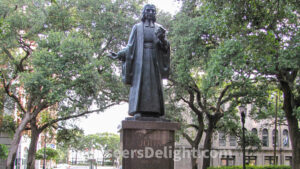
The John Wesley Monument, erected in 1969 by the John Wesley Monument Committee, honors the founder of Methodism, who served as an Anglican clergyman in colonial Georgia from 1736 to 1738. Set in the center of Reynolds Square, on the site where Wesley’s Savannah home is believed to have stood, the statue depicts him preaching outdoors, reflecting his practice of ministering in the open air, including to Native Americans, which challenged the church convention of the day. During his Savannah tenure, Wesley established what is widely regarded as America’s first Sunday school, foreshadowing Methodism’s focus on teaching and small-group faith. The bronze monument by sculptor Marshall Daugherty is located near Bay Street and City Market.
31401
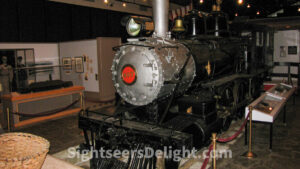
The Savannah History Museum, housed in the former Central of Georgia Depot, chronicles the history of Savannah from 1733 to modern times. Among the 40,000 artifacts housed in the museum is the bench from the movie Forrest Gump, information about Juliette Gordon Low, founder of the Girl Scouts and a steam locomotive from the early 20th century. The railroad used the building until 1972, and the Coastal Heritage Society opened the museum in 1989.
31401
Built in 1721, a dozen years before the first city in Georgia, Savannah, was founded, Fort King George was both the first English settlement on Georgia’s coast and the British Empire’s southernmost outpost in North America. It remained the southernmost settlement until 1736 when Fort Frederica was built on what is today St. Simon’s Island. With the help of historic drawings, the Lower Altamaha Historical Society and the Georgia Department of Natural Resources in 1988, a number of the fort’s structures were rebuilt, including the cypress blockhouse. The reconstructed fort is a replica of Barnwell’s original construction. Today, the park highlights the area’s 18th century cultural history, including the Guale Indians, the 17th century Spanish mission Santo Domingo de Talaje, Fort King George and the Scottish colonists. In addition, the state park features information about 19th century sawmilling.
31305
The Ocmulgee National Monument preserves traces of over ten millennia of Southeastern Native American culture. Natives first came to the area during the Paleo-Indian period hunting Ice Age mammals. While many different cultures occupied this land for thousands of years, the centerpiece of the monument is a series of earthworks built before 1000 CE by the South Appalachian Mississippian culture, a regional variation of the Mississippian culture.
31217