
Guidebooks are annoying. Just because some editor who doesn’t know me tells me which restaurant is the best or what attraction is a must-see doesn’t make it a must-see attraction. Sightseers’ Delight is dedicated to the weird, the quirky and the fun. After all, traveling is fun.
If it’s not, you’re doing it wrong.
All of the places highlighted in this ever-growing database are great. Sightseers’ Delight has visited them all. We think you should make a point to see every one of them. But, this is not a guidebook. Just a webpage to help you plan your next adventure.
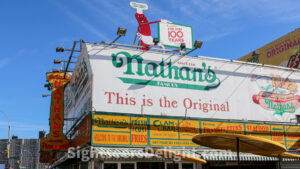
What is Coney Island and how do you describe it in 100 or so words? It’s a neighborhood, an entertainment district and a popular tourist destination. Maybe more than anything, Coney Island is quintessentially New York City. It transformed into a seaside resort by the middle of the 19th century, and amusement parks followed a few years later. While Coney Island’s popularity waned following World War II, the area has experienced a resurgence in recent years, thanks in part to the opening of the MCU Park in 2001.
Along Interstate 75 sits a definite oddity: a Titan missile. The missile, acquired from the Air Force in 1968 after it was declared obsolete, was flown from California to Warner Robins Air Base where it was stored for some time before it was given to the community. Titan I missiles were used between 1959 and 1965 and is considered the country’s first In-tercontinental Ballistic Missile (ICBM). The missile in Cordele stands on what has been dubbed Confederate Air Force Pad No. I.
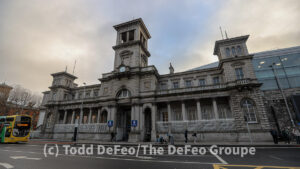
Connolly Station is Dublin’s busiest railway station and the central hub of Ireland’s rail network. Located on the north side of the River Liffey, it provides InterCity, Enterprise, and commuter services to destinations across the north, northwest, southeast, and southwest, while also serving the north–south DART line and the Luas Red Line. The station complex houses the headquarters of Iarnród Éireann, Irish Rail. Opened in 1844 as Dublin Station, Connolly is renowned for its ornate façade, featuring a distinctive Italianate tower at its center.
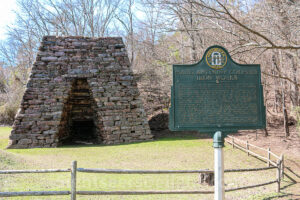
Coopers Furnace Day Use Park is open seasonally and is situated along the north bank of the Etowah River. The park has lots of single-car parking, and no trailers are allowed. This park also allows a great view of the dam from downstream. Cooper’s Iron Works is the last remaining remnant of the 19th century town of Etowah. Jacob Stroup established the works in the 1830s, and Mark Anthony Cooper purchased the ironworks in the 1840s. In 1862, Cooper sold the iron works. The Confederate States of America subsequently purchased the works, and federal soldiers, on May 22, 1864, destroyed the ironworks and mill, bringing about an end to the city’s livelihood. Following the Civil War, the town never again returned to its antebellum prominence. A smokestack is all that remains of the ironworks.
30121
Copp’s Hill Burying Ground in the North End of Boston was established on Feb. 20, 1659, as North Burying Ground and is the second oldest cemetery in the city. The hill is named for William Copp, a shoemaker who once owned the land. Among those buried in the graveyard is Robert Newman, the patriot who placed the lanterns in the steeple of Old North Church for Paul Revere’s midnight ride.
02113
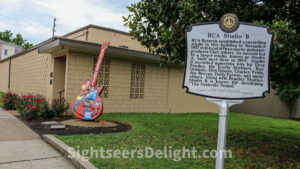
The Country Music Hall of Fame first museum opened on Music Row in 1967. The current museum — located in downtown Nashville — opened in a $37 million facility in 2001 and features various permanent and temporary exhibits dedicated to telling the history of country music, from its earliest roots to modern-day superstars. No visit to the museum would be complete without purchasing an add-on tour of RCA Studio B. Located a few blocks away from the museum, the historic studio — still in use today — has been used by some of music’s biggest stars, from The Everly Brothers to Roy Orbison to Elvis Presley.
37203
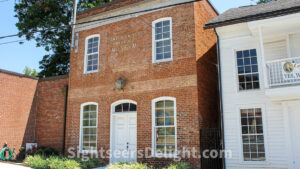
On March 30, 1842, Crawford W. Long stepped into the history books when he used Ether as a surgical anesthesia. His legacy lives on at the museum that bears his name. The Crawford W. Long Museum in the Jackson County city of Jefferson, about 25 miles from Athens, opened in 1957. It reopened in January 2010 following an 18-month renovation.
30549
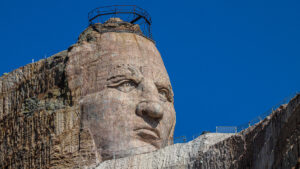
Crazy Horse Memorial in Custer County, South Dakota, is a monument currently being constructed on privately held Black Hills land. The monument depicts Oglala Lakota warrior Crazy Horse on a horse, pointing to his tribal land. Henry Standing Bear, a Lakota elder, commissioned the memorial, selecting Polish-American sculptor Korczak Ziolkowski to create it. The nonprofit Crazy Horse Memorial Foundation operates the monument. Work on the monument began in 1948 and is still far from completion. If the monument is completed as designed, it will be the world’s second tallest statue, following the Statue of Unity in India.
Crest Lawn Memorial Park in Atlanta was established in 1916 as a public burial site and spans roughly 145 acres. It is the oldest Mausoleum located west of the Allegheny Mountains and is the final resting place of more than 50,000 people. There are five different Jewish Cemeteries within the Crestlawn premises, and Casey’s Hill Cemetery is documented as a separate cemetery but is located within Crestlawn boundaries.
30318
The Crime and Punishment Museum in Ashburn, Georgia, opened in August 2003 in a bucolic community of about 4,100 located along Interstate 75. The building — known to many as “Castle Turner” — served as the county jail from about 1907 until 1993. Miles Cribb was the only inmate hanged inside the jail. Today, visitors to the museum can see the trap door that dropped, sending the condemned Cribb to his death. They can also gaze upon the blood-stained collar he was wearing at the time he was executed and see a replica of an electric chair, affectionately nicknamed “Old Sparky.”
31714