
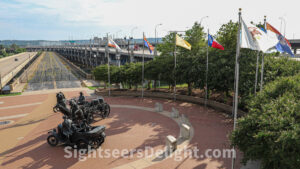
Cyrus Avery Centennial Plaza is named in honor of the “Father of Route 66.” Avery, a Pennsylvania native, created the route while serving on a federal board tasked with creating the Federal Highway System. He pushed for establishing the U.S. Highway 66 Association to pave and promote the highway. n late 2012, artist Robert Summers unveiled a sculpture titled “East Meets West.” The detailed 135 percent-scale bronze depicts Avery stopping his Ford on the 11th Street Bridge as the vehicle startled a pair of horses pulling a wagon loaded with oil barrels.
74127
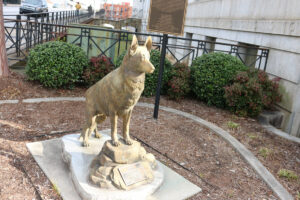
This solid bronze German Shepherd Dog DOGNY sculpture was dedicated on Sept. 11, 2013. The statue is part an American Kennel Club public art initiative. The project, “DOGNY: America’s Tribute to Search and Rescue Dogs,” honors the Canine Search and Rescue dog and handler teams who served following the Sept. 11, 2001, tragedy.
30303
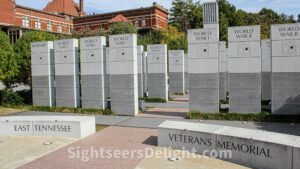
The East Tennessee Veterans Memorial includes 32 granite monuments with inscribed names of more than 6000 veterans from 35 counties in East Tennessee who have died in military service since World War I. The memorial lists names by conflict and by county. The memorial, located on a grassy plot at the northern end of Knoxville’s World’s Fair Park, also includes the names of the 14 Medal of Honor recipients from East Tennessee. Other features are a plaza entrance with a 50-foot flag pole and a 27-foot high bell tower.
37902
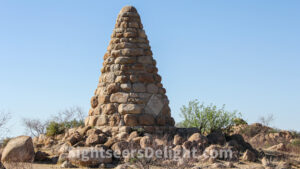
As Ed Schieffelin started prospecting for valuable minerals in southern Arizona during the latter half of the 1870s, his friends insisted he would only find his tombstone. They were wrong. Instead, he discovered silver in an area that would grow into one of the most colorful towns in the country’s history: Tombstone. Over the years, mines in Tombstone produced $85 million in silver. Schieffelin died in Oregon on May 12, 1897, but he insisted his final resting spot be in Tombstone. A 25-foot-tall monument stands atop his burial site and near the location of his original claim.
85638
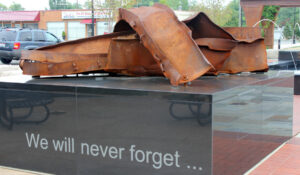
In the heart of Hilliard, a bucolic Columbus suburb, stands what is said to be one of the largest Sept. 11 memorials. First Responders Park Memorial is dedicated to first responders nationwide and aims to remind visitors that no matter where they live, they have a stake in what happened on Sept. 11. One of the memorial’s features is a trio of granite walls inscribed with the names of those who lost their lives in the attack. In addition, steel from the World Trade Center was incorporated into the memorial.
43026
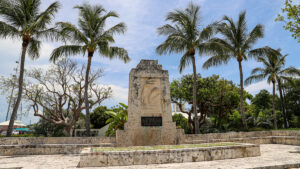
The Florida Keys Memorial, also known as the Hurricane Monument, is a landmark located in Islamorada, Florida. The monument was constructed to honor the hundreds of victims of the devastating Labor Day Hurricane of 1935, which caused widespread destruction and loss of life in the Florida Keys. The 81-foot-tall memorial is made of native keystone.
This post partially incorporates text generated with GPT-3, OpenAI’s large-scale language-generation model.
33036
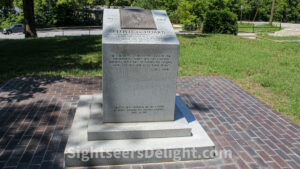
Floyd G. Hoard was the solicitor general of the Piedmont Judicial Circuit when he was killed on August 7, 1967, by a car bomb. He was known for aggressively prosecuting organized crime in the area. Local citizens dedicated the monument on the Historic Jackson County Courthouse grounds on April 19, 1997.
30549
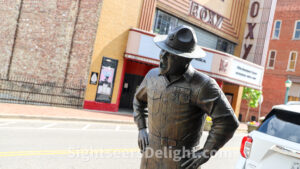
The city of Clarksville, Tennessee, unveiled the Frank Sutton Statue on Franklin Street in May 2017. Local sculptor Scott Wise created the statue of Sutton, a Clarksville native best known for portraying Sgt. Vince Carter on the 1960s CBS show “Gomer Pyle U.S.M.C.” Sutton in the South Pacific with the U.S. Army during World War II. The statue stands along Franklin Street across from the Roxy Regional Theatre. Sutton, who died in 1974, also appeared in “Gunsmoke” and “The Twilight Zone.”
37040
The Freedom Crossing Monument on the Niagara River in Lewiston, New York. Dedicated on Oct. 14, 2009, the monument honors the bravery of fugitive slaves seeking freedom in Canada and the local volunteers who assisted them. It highlights the historical significance of the Niagara River as a critical escape route on the Underground Railroad during the mid-19th century.
It was the first project the Niagara River Greenway Commission endorsed, with planning and fundraising conducted entirely by volunteers from the Historical Association of Lewiston, Inc., which conceived the project in 2006. The town of Lewiston helped fund the $230,000 via the New York Power Authority’s Niagara River Greenway Plan, supplemented by the Margaret L. Wendt Foundation and the KeyBank Foundation.