Railroads may have built Atlanta, but it’s the highways that developed the modern-day city.
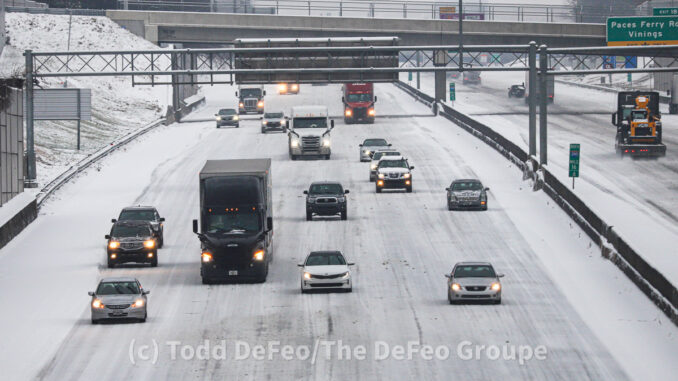
As officials begin a series of closures on Interstate 285 to rebuild the road over the coming months, it’s a fitting moment to revisit the highway that has encircled the Gate City for nearly 60 years.
“All our highways are important but this one serves a unique purpose of the collector/distributor for the other interstates and also a great service to local traffic,” Tom Moreland, who worked for the Georgia Department of Transportation for 30 years, told WSB-TV.
The Opening
Atlanta’s Perimeter officially opened with a bit of theater.
On Oct. 15, 1969, on the Fulton County side of the bridge over the Chattahoochee River, Democratic Gov. Lester Maddox marked the opening of I-285 by blasting through a cardboard barrier in a car, briefly wobbling on the hood and nearly falling off as about 250 people watched. With that, the 63-mile interstate loop around Atlanta was declared open.
The opening was framed as a major transportation milestone for Georgia. An October 1969 article in The Atlanta Constitution described the day as one of the state’s “truly great days for transportation,” noting that I-285 was not the only highway development coming online.
The Gainesville Connector linking Gainesville and I-85 had opened, and a segment of I-75 from Morrow to McDonough was also opening, making limited-access travel from Atlanta toward Miami possible.
The Perimeter was built largely with federal support. Frank Carter, president of the Atlanta Chamber of Commerce, noted that 90% of the funding for the $97 million road came from the federal government. He described the highway as a new lifeline for Atlanta, but also warned that the city remained caught in a traffic “stranglehold,” a reminder that even ambitious projects bring new challenges.
“Atlanta today is encircled by the federals, but today we are enjoying it,” Carter told The Atlanta Constitution at the time.
Even on opening day, officials were already looking beyond I-285. Maddox suggested that additional north-south expressway capacity would eventually be necessary on Atlanta’s west side, and predicted that a second perimeter might one day be needed. He also envisioned rapid transit running down the median of the newly opened I-285, with feeder lines serving downtown Atlanta and nearby cities such as Decatur, Lawrenceville and Griffin.
Nearing Completion
By August 1968, Atlanta’s Perimeter was no longer just an idea on a planning map; it was a nearly complete concrete loop, with only about 13 miles left before I-285 would fully encircle the city.
The Perimeter had been taking shape in pieces for years, gradually linking suburban communities, industrial corridors and the region’s growing highway system into a 63-mile interstate loop.
Supporters saw I-285 as an economic engine, a road that would strengthen metropolitan Atlanta’s economy by giving industry better access around the city without forcing traffic through downtown. An article in The Atlanta Constitution argued that the Perimeter would help the region compete for new industrial and commercial development, especially in areas with quick access to interstates and airports.
Even before the loop was finished, Atlanta’s traffic problems were obvious. The newspaper noted that the Perimeter was expected to help traffic move, but not magically solve congestion. True to Atlanta’s pattern, the answer was already more roads: additional expressways, connectors, and future improvements were being discussed before the paint was dry on the last sections.
An Idea
Before Atlanta had the Perimeter, it had an idea: build a limited-access highway around the city so traffic did not have to squeeze through the middle of town.
A Dec. 14, 1953, article in The Atlanta Journal reported that federal officials had approved the first leg of what was then called an “outer belt” highway. The proposed route was to begin near the Lockheed plant in Marietta and run southeast toward Atlanta’s southside, tying into major routes, including U.S. Highways 41, 23 and 42.
The road was envisioned as a partial beltway that would eventually link several radial highways and help move traffic around Atlanta instead of into it. Officials described the plan as an expressway-type limited-access route, four lanes wide where needed and two lanes in some early sections, with a 200-foot right-of-way.
The first leg alone was expected to run about 16 miles and cost roughly $4 million. The broader proposal contemplated an eventual 50-mile route around Atlanta, connecting areas near Marietta, Doraville, Tucker, Decatur and East Point.
At the time, the highway was described in practical terms: a way to relieve traffic, serve industry, and connect the region’s growing suburbs and employment centers. But in hindsight, the 1953 proposal reads like the opening chapter of one of metro Atlanta’s defining transportation stories.
What began as an “outer belt” near Lockheed would eventually become Interstate 285 — the concrete circle that reshaped how Atlanta grew, moved and sprawled.
Highways Won’t Be Enough
Long before Atlanta finished building the Perimeter, traffic engineers warned that expressways alone would not be enough.
A vintage Atlanta newspaper article headlined “Expressways Alone Won’t Meet City’s Future Needs, Studies Show” captured a familiar-sounding concern: even a major highway system would only temporarily help downtown traffic unless the city also expanded surface streets, improved circulation and eventually built rapid transit.
The article cited studies by City Traffic Engineer Karl Bevins, who warned that Atlanta’s existing street network would be unable to carry expected future traffic. Even with a regional expressway system, many trips would still depend on local streets to reach their final destination.
Once drivers left the freeway, Atlanta still needed a stronger street grid, better cross-town routes and improved connections between major corridors. The article also noted that rail rapid transit would be needed to accommodate future growth.
Planners were already looking toward a larger regional transportation system, recognizing that highways and surface streets alone would not be enough as Atlanta’s population and commuter traffic increased.
Nearly six decades on, the same challenge remains: Atlanta has spent generations adding lanes, interchanges, and bypasses, yet congestion continues to shape daily life across the region. The ongoing closure of I-285 only adds to the chaos.