
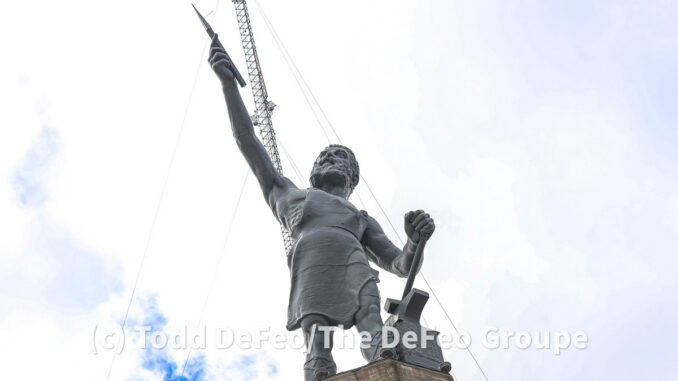
BIRMINGHAM, Alabama — The 56-foot-tall cast‑iron statue standing vigil hasn’t just watched over the city for nearly a century; it’s stood as a silent reminder of the Magic City’s steel-making past.
Giuseppe Moretti sculpted the statue of Vulcan, the Roman god of the forge, using local iron for the 1904 World’s Fair in St. Louis. It was meant to show off Birmingham’s industrial ambitions.
However, after the fair, the statue’s story is decidedly less glamorous. It returned to Birmingham in pieces and sat by the railroad tracks for a while because no one paid the freight bill.
That rough start fits Birmingham, a city that quickly garnered the nickname the Pittsburgh of the South. The city’s industry grew quickly and confidently, though not always neatly
In the 1930s, the statue finally found a home on Red Mountain. From there, Vulcan became a source of civic pride, a curiosity and a local joke.
Over the years, the statue has shown both the city’s ambitions and its odd sense of humor. Locals like to point out that the statue’s bare backside has been a landmark of its own for years.
For a while, Vulcan held advertising props instead of his usual tools. His neon torch, which generally glowed green, turned red after fatal traffic accidents.
Whatever its history, the statue is a real piece of Birmingham’s industrial past. Today, the site is both a landmark and a lookout. People come for the view as much as the story.
The statue’s job hasn’t changed much. It still reminds locals and visitors alike why Birmingham is here and what built it.
But its cheekiest feature has long stolen the show.


Be the first to comment