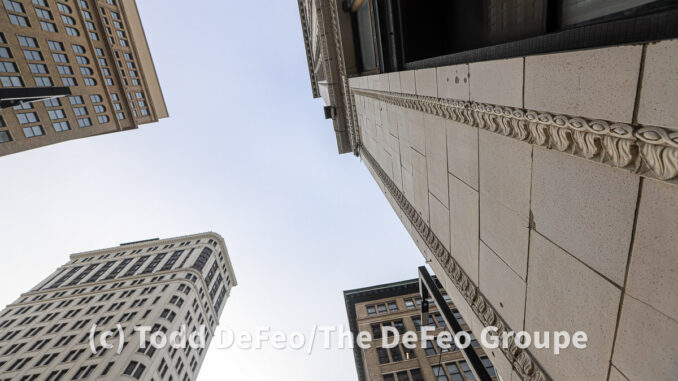
BIRMINGHAM, Alabama — The corner of 20th Street and 1st Avenue North in downtown Birmingham seems like any other corner in the city.
Sure, it has a steel-framed skyscraper at each corner, but does that alone make it unique?
However, it’s those four buildings that gave rise to the corner’s nickname: the “Heaviest Corner on Earth.” The buildings that emerged — the 10-story Woodward Building in 1902, the 16-story Brown Marx Building in 1906, the 16-story Empire Building in 1909, and the 21-story American Trust and Savings Bank Building in 1912 — were among the tallest in the South.
The nickname apparently originates from a January 1911 article in Jemison Magazine, a local promotional publication. Although the article was titled “Birmingham to Have the Heaviest Corner in the South,” promoters didn’t settle, expanding the title to the entire Earth.
Two local architects, William C. Weston and William L. Welton, designed the buildings, working with out-of-state firms on three of the four buildings.
The title stuck, and it’s official now as the corner was added to the National Register of Historic Places in 1985, forever cementing its status. Three were added to the registry individually in 1982 and 1983.
Today, they stand as symbols of the city’s rapid rise as an industrial powerhouse, and it’s that ambition that helped shape modern Birmingham.
“And that’s kind of how the rest of the buildings got their moniker,” Connor Marullo, assistant archivist at the Birmingham Public Library, told WBMA-TV.
“Because it used to be the heaviest corner just in the South, but that legend kind of grew and as it appeared in different magazines,” Marullo added.
Anyone looking to enjoy the corner in a different way might consider starting at the Elyton Hotel. The 111-room luxury hotel, complete with a rooftop bar and restaurant, is located in the Empire Building.