
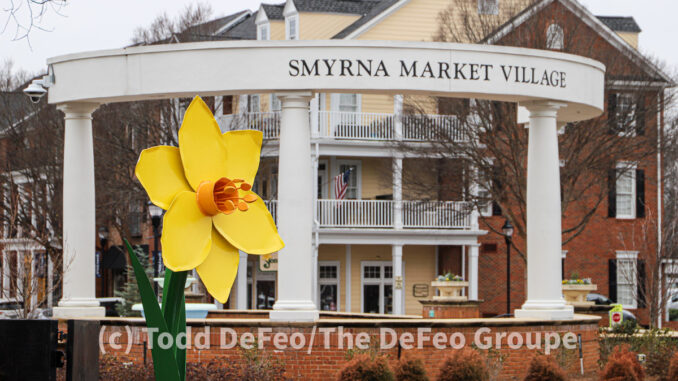
SMYRNA, Georgia (Sightseers’ Delight) — Smyrna loves bragging about its rich history, often citing the Western & Atlantic line and the historic trolley that connected it to downtown Atlanta.
Long before Smyrna became synonymous with manicured suburban living, redevelopment projects, and inevitable arguments over Atlanta commuter traffic, the town made its mark on the map through sheer agricultural ambition. Modern Cobb County suburban sprawl wasn’t built on steel rails; it was fueled by chicken feed.
According to the March 11, 1911, edition of the Atlanta Georgian, the town’s real origin story is considerably more feather-brained. According to a dispatch by reporter Claude B. Nealy, Smyrna didn’t just grow alongside the tracks—it was literally hatched by a massive poultry farm.
“For this beautiful little town of 1,000 inhabitants, situated 12 miles from Atlanta, on the Western and Atlantic and the Atlanta Northern Interurban railways, can trace its present prosperity and progress directly to the chicken–literally builded upon the fine feathered fowl, as it were,” Nealy wrote.
“In other words, Smyrna, as its leading citizens agree, owes its rapid and substantial growth of the past few years to the chicken industry-to the marvelous success of Belmont farm,” Nealy added.
The article credited a single operation for transforming Smyrna from an obscure stop on the line into a thriving community of 1,000 residents in just over a decade.
That operation was Belmont Farm, a sprawling 36-acre poultry powerhouse located a half-mile north of town. Run by Loring Brown — a man described as equal parts showman, businessman, and mad scientist of chicken breeding — the farm boasted dozens of specialized incubator buildings and thousands of laying hens.
Belmont didn’t just sell eggs for breakfast; it shipped prize-winning breeding stock and hatching eggs to customers nationwide.
Nealy claimed that local leaders believed Belmont’s national reputation pulled new residents in “magnet-like,” asserting that an outrageous 95% of the town’s population had moved to Smyrna because of the farm. While that number smells heavily of early 20th-century PR spin, the core concept is unmistakable: Smyrna was essentially a company town, just with beak-to-tail marketing.
Naturally, the real estate pitch had a transit angle. Visitors didn’t even have to walk from the train station—they could simply ride the Atlanta Northern interurban trolley and step off directly at Belmont’s dedicated stop right in front of the farm gates.




Be the first to comment