Guidebooks are annoying. Just because some editor who doesn’t know me tells me which restaurant is the best or what attraction is a must-see doesn’t make it a must-see attraction. Sightseers’ Delight is dedicated to the weird, the quirky and the fun. After all, traveling is fun.
If it’s not, you’re doing it wrong.
All of the places highlighted in this ever-growing database are great. Sightseers’ Delight has visited them all. We think you should make a point to see every one of them. But, this is not a guidebook. Just a webpage to help you plan your next adventure.
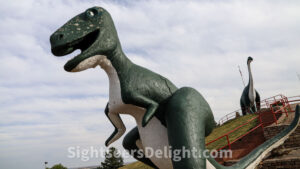
In the 1930s, work began on Rapid City’s quirky and beloved Dinosaur Park. The idea originated after dinosaur bones and footprints were found in the area. The goal was to convince travelers to Mount Rushmore to visit Rapid City, hoping to change the area from a pass-through town to a must-stop destination. Sculptor Emmet Sullivan and his team used metal pipe frames, wire and concrete to build dinosaurs. Many workers who helped carve Mount Rushmore were hired for the project. Officials initially selected five dinosaurs, but the group expanded to seven when two smaller dinosaurs were added near the gift shop. In the 1950s, the dinosaurs, originally painted gray, were given their green and white color scheme.
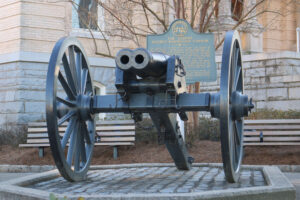
The Double-Barreled Cannon
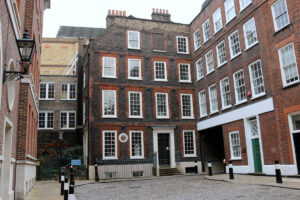
Dr. Samuel Johnson wrote the dictionary. Literally. Between 1748 and 1759, Johnson paid a £30 rent, and while living in the house compiled his seminal work, A Dictionary of the English Language, published in 1755 and heralded as “one of the greatest single achievements of scholarship.” Wool merchant Richard Gough built the house during the latter half of the 17th century, and after Johnson moved out, the building was used for a number of purposes. The edifice was damaged during World War II, damage that can still be seen today.
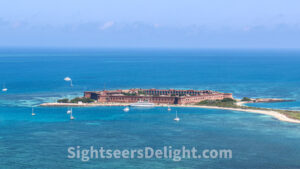
Dry Tortugas National Park, situated about 68 miles west of Key West, preserves Fort Jefferson and the seven Dry Tortugas islands, the westernmost and most isolated Florida Keys. Fort Jefferson, a massive but unfinished coastal fortress, is the largest brick masonry structure in the Western Hemisphere and includes more than 16 million bricks. The park, accessible by seaplane and boat, is popular for its abundant sea life, tropical bird breeding grounds and colorful coral reefs. Dry Tortugas National Park is part of the Everglades & Dry Tortugas Biosphere Reserve, which UNESCO established in 1976 under its Man and the Biosphere Programme.
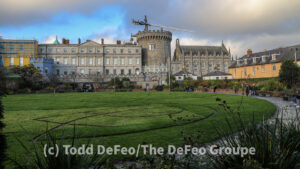
Dublin Castle, in the center of Dublin, stands on one of Ireland’s most important historic sites. The area is named for the Black Pool, or Dubh Linn, which lay where the River Liffey and the River Poddle met, near the present castle gardens. The site may first have held an early Gaelic fort and later a Viking stronghold. From 1204 until 1922, Dublin Castle served as the seat of English, and later British, rule in Ireland.
Although much of the medieval castle was destroyed in a fire in 1684, important parts of the earlier complex survive, including the 13th-century tower and medieval undercroft. After the fire, the State Apartments were built as the viceregal court’s residential quarters. They remain among the most significant ceremonial interiors in Ireland and are now used for presidential inaugurations, state visits and other official events.
The castle complex also includes the Chapel Royal and the gardens to the south, which add another layer to the site’s appeal. More than a single building, Dublin Castle preserves centuries of political, architectural and civic history at the heart of the Irish capital.
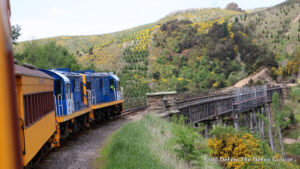
Dunedin Railways, formerly known as the Taieri Gorge Railway, is the name of Dunedin Railways Limited, an operator of a railway line and tourist trains based at Dunedin Railway Station in the South Island of New Zealand. The company is a council-controlled trading organization wholly owned by Dunedin City Council through its holding company Dunedin City Holdings Limited.
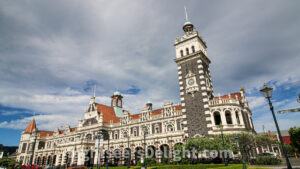
Dunedin railway station in Dunedin on New Zealand’s South Island, designed by George Troup, is the city’s fourth station. It is nicknamed “Gingerbread George.”
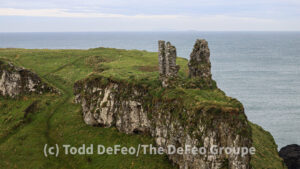
Dunseverick Castle is the site of an ancient stronghold on the Causeway Coast, with archaeological evidence of an Iron Age promontory fort and a long tradition identifying it as the northern endpoint of one of Ireland’s five great roads. Saint Patrick is said to have visited the site in the 5th century, baptizing Olcán, who later became a bishop. The fort was attacked by Viking raiders in 870 AD, and in the 6th century it served as the seat of Fergus Mór MacEirc, King of Dál Riata, a figure linked to the departure of the Lia Fáil to Scotland. The castle later passed to the Earls of Ulster, the O’Cahans and the McDonnells before being destroyed in the 1640s. Today, only the gate lodge ruins remain.
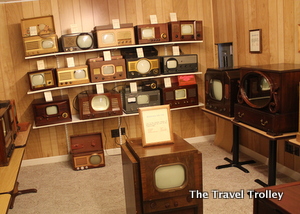
The 4,200-square-foot museum, located in Hilliard, Ohio, a western suburb of Columbus, boasts more than 150 television sets, including mechanical sets from the 1920s and American and British equipment from the 1930s, 1940s and 1950s. Many of the sets are in working order. The museum’s most popular exhibits include the collection of early color sets, a DuMont Royal Sovereign, the working Baird mechanical set and the RCA remote telecasting van. The Early Television Foundation, a non-profit organization that operates the museum, is always looking to expand its collection of equipment.