Guidebooks are annoying. Just because some editor who doesn’t know me tells me which restaurant is the best or what attraction is a must-see doesn’t make it a must-see attraction. Sightseers’ Delight is dedicated to the weird, the quirky and the fun. After all, traveling is fun.
If it’s not, you’re doing it wrong.
All of the places highlighted in this ever-growing database are great. Sightseers’ Delight has visited them all. We think you should make a point to see every one of them. But, this is not a guidebook. Just a webpage to help you plan your next adventure.
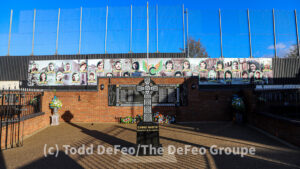
The Clonard Martyrs Memorial Garden on Bombay Street in west Belfast is one of the area’s best-known memorial sites connected to the Troubles.
Located near the Falls-Shankill interface, it commemorates IRA members, former prisoners, political activists and civilians from the Clonard area. The garden is divided into three linked sections, enclosed by walls, railings and gates, with a large Celtic cross and a central plaque in the middle section and additional plaques and memorial benches in the side sections.
Its location on Bombay Street gives the site added historical significance. In August 1969, during some of the earliest large-scale violence of the Troubles in Belfast, Catholic houses on Bombay Street were burned, making the street one of the best-known flashpoints of that period. Gerald McAuley, a 15-year-old member of Fianna Éireann, was killed during the attack while helping people flee.
The memorial garden was created by the Greater Clonard Ex-Prisoners’ Association in the early 2000s.
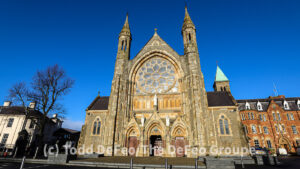
Clonard Monastery, built in 1911 to replace a small brick church on Clonard Street, is now one of Ireland’s best-known churches and the home of the annual Clonard Novena, which draws thousands of visitors each year. The building served as a shelter during the Belfast Blitz in World War II, protecting residents from bombing raids. Decades later, it became a key location in the Northern Ireland peace process, hosting private discussions between Fr Alec Reid, Gerry Adams and John Hume. These meetings helped advance dialogue and earned the monastery the title “The Cradle of Peace.”
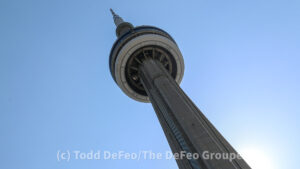
CN Tower looms large over the city of Toronto. The idea for the iconic communications and observation tower dates to the late 1960s when Canadian National Railway wanted to build a structure that would, in part, symbolize the railroad’s strength. The tower, built on former railroad right-of-way, opened to the public in June 1976. Canadian National sold the tower in 1995. Today, the tower is the centerpiece of the entertainment center along Front Street. The tower, which is home to a rotating restaurant in addition to the observation deck, is within walking distance of the Rogers Center, Union Station and the 17-acre Roundhouse Park.
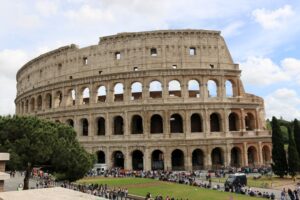
The Colosseo or Colosseum has lasted generations and is perhaps the best and most widely-known symbol of Rome’s past. Started in 72 AD, the Colosseum could hold 50,000 people, and it could be emptied in a matter of minutes and had a retractable roof. But, if that’s not outrageous enough, the Romans at times filled the stadium with water so they could reenact sea battles for war-loving crowds. Today, the building is perhaps best remembered for the gladiator fights that once took place there. The Colosseum remained in us until it was damaged in a fire in 217, giving it a roughly 145-year run.
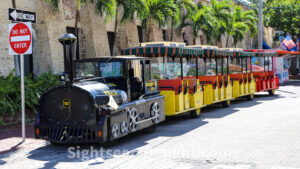
The Conch Tour Train is a popular tourist attraction in Key West, Florida, that takes visitors on a journey through the island’s rich history and culture. The train travels through the historic Old Town district, passing by notable landmarks such as the Ernest Hemingway Home and Museum, the Key West Lighthouse, and Mallory Square. Along the way, a knowledgeable tour guide shares fascinating stories and interesting facts about the island’s past, including its colorful characters, architecture, and maritime heritage. The Conch Tour Train is a fun and educational experience that provides visitors with a unique way to explore Key West.
This post partially incorporates text generated with GPT-3, OpenAI’s large-scale language-generation model.
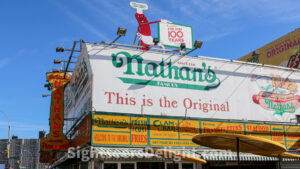
What is Coney Island and how do you describe it in 100 or so words? It’s a neighborhood, an entertainment district and a popular tourist destination. Maybe more than anything, Coney Island is quintessentially New York City. It transformed into a seaside resort by the middle of the 19th century, and amusement parks followed a few years later. While Coney Island’s popularity waned following World War II, the area has experienced a resurgence in recent years, thanks in part to the opening of the MCU Park in 2001.
Along Interstate 75 sits a definite oddity: a Titan missile. The missile, acquired from the Air Force in 1968 after it was declared obsolete, was flown from California to Warner Robins Air Base where it was stored for some time before it was given to the community. Titan I missiles were used between 1959 and 1965 and is considered the country’s first In-tercontinental Ballistic Missile (ICBM). The missile in Cordele stands on what has been dubbed Confederate Air Force Pad No. I.
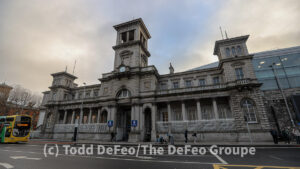
Connolly Station is Dublin’s busiest railway station and the central hub of Ireland’s rail network. Located on the north side of the River Liffey, it provides InterCity, Enterprise, and commuter services to destinations across the north, northwest, southeast, and southwest, while also serving the north–south DART line and the Luas Red Line. The station complex houses the headquarters of Iarnród Éireann, Irish Rail. Opened in 1844 as Dublin Station, Connolly is renowned for its ornate façade, featuring a distinctive Italianate tower at its center.
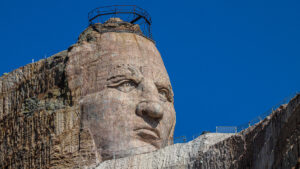
Crazy Horse Memorial in Custer County, South Dakota, is a monument currently being constructed on privately held Black Hills land. The monument depicts Oglala Lakota warrior Crazy Horse on a horse, pointing to his tribal land. Henry Standing Bear, a Lakota elder, commissioned the memorial, selecting Polish-American sculptor Korczak Ziolkowski to create it. The nonprofit Crazy Horse Memorial Foundation operates the monument. Work on the monument began in 1948 and is still far from completion. If the monument is completed as designed, it will be the world’s second tallest statue, following the Statue of Unity in India.