
Guidebooks are annoying. Just because some editor who doesn’t know me tells me which restaurant is the best or what attraction is a must-see doesn’t make it a must-see attraction. Sightseers’ Delight is dedicated to the weird, the quirky and the fun. After all, traveling is fun.
If it’s not, you’re doing it wrong.
All of the places highlighted in this ever-growing database are great. Sightseers’ Delight has visited them all. We think you should make a point to see every one of them. But, this is not a guidebook. Just a webpage to help you plan your next adventure.
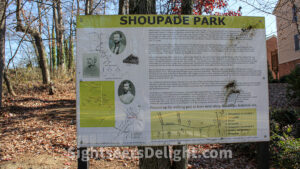
Shoupade Park preserves a rare but essential remnant of the Civil War’s River Line. Confederate Brigadier Gen. Francis Shoup in 1864 built a series of earthen forts shaped like arrowheads large enough to hold 80 soldiers. The fortification, known as “Shoupades,” allowed them to fire shots to the right, left and straight ahead as the enemy approached. Confederate troops wanted the shoupades to stop Union troops from crossing the Chattahoochee River and entering Atlanta. Modern development wiped out most of the Shoupades over the years. However, through an agreement with a developer, the city of Smyrna helped preserve one of the works. A shoupade model is on display at the Smyrna Museum.
30080
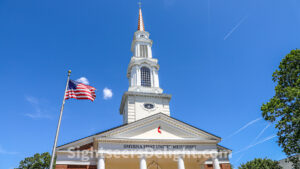
Smyrna First United Methodist Church in downtown Smyrna, Georgia, is one of the oldest institutions in the Jonquil City, dating to about 1838. The current structure dates to June 1967, replacing a five-and-a-half-decade-old structure. In 1911, the church built its first brick structure, an edifice along Atlanta Road.
30080
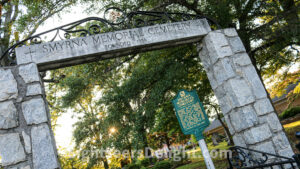
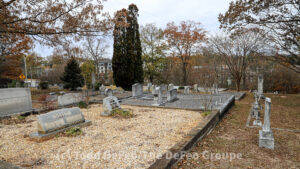
Smyrna Memorial Cemetery in Smyrna, Georgia, offers a quiet but important link to the city’s early history. Located near Memorial Place and Atlanta Road, just steps from Smyrna Market Village, the cemetery is traditionally said to have been founded by Smyrna Methodist Church in 1838. Today, it stands as one of the city’s most significant historic sites and a place where visitors can connect with generations of Smyrna residents.
The cemetery is the final resting place of many notable local figures, including John Moore, who served as Smyrna’s first mayor after the city was incorporated on Aug. 23, 1872. Although 638 people are believed to be buried there, only about 238 graves are marked with headstones. A 1999 archaeological survey identified 395 graves that had previously been lost to history, underscoring how much of the cemetery’s story had faded from view over time.
The earliest marked grave is that of Elijah H. Fleming, who died on April 8, 1848. His daughter Mary, who died on March 14, 1858, at about 17 years old, has the second-oldest marked grave.
30080
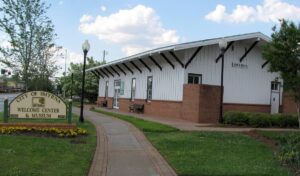
The Smyrna Museum in Smyrna, Georgia, offers visitors a concise but meaningful introduction to the history of the Jonquil City.
Since officially opening on April 25, 1999, the museum has been dedicated to preserving the stories, images and artifacts that help explain Smyrna’s growth from its earliest days to the present. Located in the heart of the city, it is an easy stop for anyone interested in local history, community identity or the broader story of metro Atlanta.
The 1,500-square-foot museum is housed in a replica of Smyrna’s railroad depot, which dates to about 1905 and was razed in 1959. Inside, the revamped museum displays more than 100 artifacts tracing Smyrna’s history from prehistoric Native American settlement through modern times. The museum also holds thousands of photographs, a range of exhibits and displays, and genealogical research materials that add depth for visitors who want to explore the city’s past in greater detail.
After closing in July 2018 for a complete redesign, the museum reopened in November 2019 with new exhibits designed to support Georgia Social Studies Standards. Admission is free, though donations are welcome.
30080
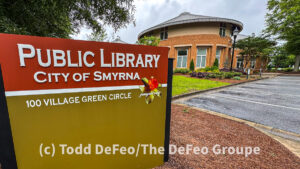
Smyrna Public Library in Smyrna, Georgia, traces its roots to 1936, when the Smyrna Women’s Club opened the city’s first library in shared space with just 50 books on a single shelf. Boy Scouts and other local children helped grow the collection by going door-to-door with wheelbarrows to collect donated books. Within two years, the library had grown to 1,400 items, an early sign of the role it would come to play in community life.
Today, the library is recognized as the oldest city-operated library in Georgia and remains an important civic institution in the heart of Smyrna. In addition to its lending collection, it regularly hosts art exhibits and speakers on topics of local and regional interest, giving visitors and residents another way to engage with the community.
The library’s history also reflects Smyrna’s growth over time. A 4,000-square-foot building on King Street opened during Mayor George Kreeger’s first term, with additions following in 1969 and 1973. When the current library opened on the Village Green in August 1991, the earlier building took on new roles before it was eventually demolished in 2002.
30080
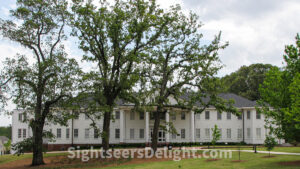
Taylor-Brawner Park in Smyrna, Georgia, combines public green space, including a playground, gazebo, walking trails, a pavilion and open green space, with two of the city’s most important historic buildings. Brawner Hall and the Taylor-Brawner House, two structures that help connect the property to Smyrna’s earlier history.
The roughly 11-acre property was once part of the Brawner Hospital campus, which the city of Smyrna acquired in 2001 with plans to rehabilitate the historic hospital building for office and meeting space while turning the surrounding grounds into a passive park. Funded through a voter-approved $24 million parks bond referendum, work on the site began in 2007 and was completed in April 2009.
The Taylor-Brawner House, a Folk Victorian home dating to about 1890, was preserved after local citizens organized a fundraising effort and created the Taylor-Brawner House Foundation. The house now serves as a small events venue, while the broader park remains one of Smyrna’s best-known civic and historic spaces.
30080

In response to growing suburban sprawl in the mid-1980s, Smyrna’s mayor and City Council opted to rebuild the downtown area to create a family-friendly environment and community gathering space. This led to Smyrna’s “Village Green,” which includes a library, community center, private housing, retail and office space, a public safety facility and a 22,000-square-foot City Hall.
30080
Milton C. Lively donated land for the cemetery around the time the city was established in 1870, naming the road leading to Cemetery Street. Initially, two streets connected the town to the cemetery: North Cemetery Street and South Cemetery Street. After Buford Highway was built in the 1930s, South Cemetery Street was renamed Carlyle Street; the portion of North Cemetery Street west of Buford Highway became Holcomb Bridge Road in 2012. In 1916, the city acquired an additional nine acres from Lively’s descendants, expanding the cemetery to its current size of roughly 3.5 acres. The remaining six acres were transformed into Cemetery Field for sporting events in the early 1970s, with renovations completed by Gwinnett County in 1986. Residents erected the pavilion at the cemetery entrance in 1922.
30071
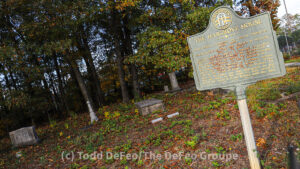
Along a busy stretch of Windy Hill Road lies a 19th century cemetery, the last vestages of the antebellum residence of Asbury Hargrove. Roughly 20 people are buried in the cemetery. Hargrove was born in 1809 and died in 1879. Between July 6-15, 1864, Brig. Gen. Edward M. McCook used the residence as his headquarters.
30067
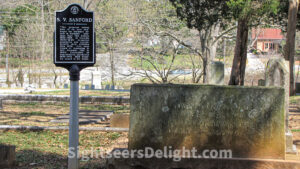
The Marietta City Cemetery, adjacent to Marietta Confederate Cemetery, was established in the 1830s. The city cemetery is the final resting place to a number of the city’s prominent denizens, including S.V. Sanford, the namesake for the University of Georgia’s football stadium. It is also where 13-year-old Mary Phagan was buried after she was killed April 26, 1913.
30064