
Guidebooks are annoying. Just because some editor who doesn’t know me tells me which restaurant is the best or what attraction is a must-see doesn’t make it a must-see attraction. Sightseers’ Delight is dedicated to the weird, the quirky and the fun. After all, traveling is fun.
If it’s not, you’re doing it wrong.
All of the places highlighted in this ever-growing database are great. Sightseers’ Delight has visited them all. We think you should make a point to see every one of them. But, this is not a guidebook. Just a webpage to help you plan your next adventure.
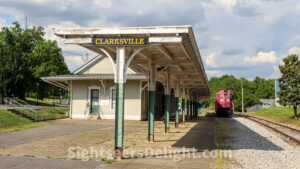
Today, the “L&N Depot” is a centerpiece of the Clarksville, Tennessee, community and a popular gathering place for the community. It is also a gateway to the city’s railroad history. Long before the city purchased the historic structure, the railroad building served as the gateway to the community. The depot’s history harkens back to the earliest days of railroading in the community — and the Memphis, Clarksville & Louisville Railroad.
37040
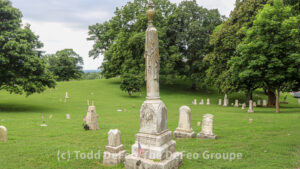
Riverview Cemetery in Clarksville, Tennessee, was established on February 23, 1800. Early settler Valentine Sevier donated the land and is the first person recorded interred in Riverview. Its hillside location was chosen to avoid dangers, as traveling along the Cumberland River to flatter land would have posed risks. The cemetery is the final resting place for notable early pioneers and civic leaders. It also contains the remains of men and women from all American wars, including two Revolutionary War veterans and a mass grave of more than 125 Confederate soldiers, reinterred from elsewhere. Initially referred to as the “city cemetery,” its name was changed to Riverview Cemetery on June 7, 1929. Riverview, the city’s only cemetery, remains active and is regarded as the oldest known public burial ground in the region.
37040
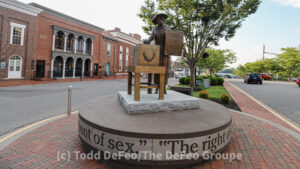
Tennessee Triumph on Public Square in downtown Clarksville, Tennessee, commemorates the centennial of the ratification of the 19th Amendment and the women who helped secure the right to vote. The monument was unveiled and dedicated on Aug. 15, 2020, as part of Clarksville’s observance of the anniversary and to establish the city as a stop on Tennessee’s Woman Suffrage Heritage Trail, which runs from Chattanooga to Memphis.
The 7-foot bronze statue is 1.25 times life size and depicts a woman casting her first ballot. She faces F&M Bank on Public Square, placing her vote in a ballot box while holding a scroll reading, “Women use your vote.” Rather than honoring a single individual, the monument commemorates the Clarksville women who worked for suffrage and participated in that first election after ratification.
The project was led by the Tennessee Triumph Steering Committee, a group of 20 women community leaders who spent two years raising money and guiding the effort. Ellen Kanervo and Brenda Harper helped organize the committee, which ultimately selected a design by Phoenix- and Nashville-based artist Roy Butler. The statue is Clarksville’s 27th piece of public art.
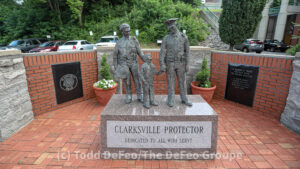
The Clarksville Protector statue in downtown Clarksville, Tennessee, stands next to the Clarksville Police Department as a memorial to the city’s fallen law enforcement officers. Unveiled during a ceremony honoring officers killed in the line of duty, the bronze work depicts real Clarksville police officers rather than generic figures, giving the monument a strong local identity and making it more than a symbolic tribute.
The statue grew out of an idea from Clarksville Police Officer Jackie Ashby, who was inspired during a trip to Washington, D.C., with her husband, Lt. Phil Ashby. She later connected with Brodin Studios of Minnesota, founded by brothers Roger and Neil Brodin, former Minneapolis police officers whose artwork has become well known in law enforcement and public safety circles. Their Protector pieces have appeared in cities across the country.
In Clarksville, the sculpture shows an officer holding a child’s hand, an image meant to reflect both protection and compassion. It also serves as a reminder of the officers the city has lost over the years. Seven Clarksville police officers and one K-9 have been killed in the line of duty.
37040
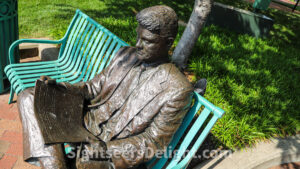
Clarksville firefighter and sculptor Scott Wise created “The Day After,” also known as “The Seated Piece.” Main Street Clarksville commissioned the public art, the group’s last. The statue’s title refers to January 23, 1999, the day after a tornado struck downtown Clarksville. The statue, described by the artist as “Joe Public,” is reading a replica of the January 23, 1999 edition of The Leaf-Chronicle newspaper, which is located across Commerce Street from the statue. The statue was formally unveiled on October 30, 2003, and Main Street Clarksville donated it to Montgomery County after its unveiling.
37040
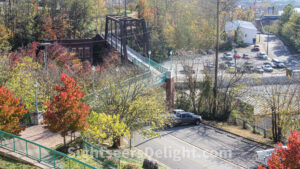
The Upland Trail is a walking path in the heart of downtown that dates to the late 1990s. The trail currently links the Riverwalk to an overlook bridge at the north end of Valleybrook Park. The initial portion of the project extended the trail from the pedestrian overpass on Riverside Drive and College Street, alongside many of Clarksville’s historical buildings and homes, and uses a former railroad bridge near the park. The remainder of Phase II will eventually continue the trail into Valleybrook Park.
37040
The Manatee Observation and Education Center is located on the waterfront in downtown Fort Pierce, Fla. The environmental education and wildlife viewing center opened on Nov. 1, 1996, in time for Manatee Awareness Month. The mission of the Manatee Observation and Education Center is to promote understanding and responsible actions for the protection of the Treasure Coast’s fragile ecosystems and their inhabitants. It does that through exhibits and an outdoor viewing platform where visitors can watch manatee.
34950
Dr. Charles Bressler-Pettis conceive the idea for the Monument of States in the dark days after the attack on Pearl Harbor. Bressler-Pettis wrote to governors and asked them to send stones for a monument; they obliged. The 40-foot-tall monument is topped by a 562-pound bald eagle made of concrete and was built using stones from all 48 states (at the time of its completion). Bressler-Petti also included stones he and his wife collected from other places. The structure, dedicated in March 1943 and located at the corner of Monument Avenue and Johnston Street, contains 1,500 rocks from all 50 states and 22 countries. A number of parties, including tourists, governors, a prime minister and President Franklin D. Roosevelt, also donated stones to the cause. While it can’t be confirmed, a human skull is also alleged to be included in the mix. Interestingly some of Bressler-Petti’s ashes are said to be buried in the monument.
34741
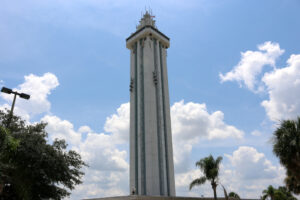
The Clermont Citrus Tower first opened to visitors in 1956. It took 13 months, roughly $300,000, five million pounds of concrete and 149,000 pounds of reinforced steel to build the tower. Counting its antenna, the tower reaches over 500 feet above sea level, making it the highest observation point in the Sunshine State. At one point, more than 500,000 people visited the tower every year. However, the 1964 extension of the Florida Turnpike provided a waste route for motorists and the tower’s popular among travelers began to wane. Then, that roadside oddity called Walt Disney World opened. The rest, as they say, is history.
34711
Located off of Interstate 75 in Ocala, Florida, the Don Garlits Museum of Drag Racing features an amazing array of cars and vintage engines Garlits has rebuilt for display. Garlits’ impact on the sport is immeasurable. He was the first driver to officially surpass a number of speed marks, including hitting 270 mph on a quarter-mile track and 200 mph on a 1/8-mile track. Artifacts that help tell the story of drag racing’s history are featured throughout. Highlights include the Swamp Rat I, the car Garlits raced when he set his first world record; the Swamp Rat 14, the first rear engine car Garlits built; and the Swamp Rat 34.
34473