
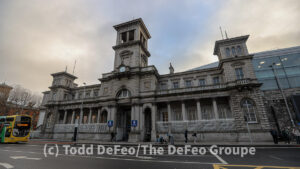
Connolly Station is Dublin’s busiest railway station and the central hub of Ireland’s rail network. Located on the north side of the River Liffey, it provides InterCity, Enterprise, and commuter services to destinations across the north, northwest, southeast, and southwest, while also serving the north–south DART line and the Luas Red Line. The station complex houses the headquarters of Iarnród Éireann, Irish Rail. Opened in 1844 as Dublin Station, Connolly is renowned for its ornate façade, featuring a distinctive Italianate tower at its center.
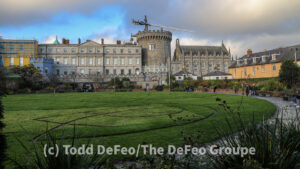
Dublin Castle, in the center of Dublin, stands on one of Ireland’s most important historic sites. The area is named for the Black Pool, or Dubh Linn, which lay where the River Liffey and the River Poddle met, near the present castle gardens. The site may first have held an early Gaelic fort and later a Viking stronghold. From 1204 until 1922, Dublin Castle served as the seat of English, and later British, rule in Ireland.
Although much of the medieval castle was destroyed in a fire in 1684, important parts of the earlier complex survive, including the 13th-century tower and medieval undercroft. After the fire, the State Apartments were built as the viceregal court’s residential quarters. They remain among the most significant ceremonial interiors in Ireland and are now used for presidential inaugurations, state visits and other official events.
The castle complex also includes the Chapel Royal and the gardens to the south, which add another layer to the site’s appeal. More than a single building, Dublin Castle preserves centuries of political, architectural and civic history at the heart of the Irish capital.
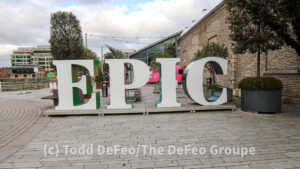
EPIC The Irish Emigration Museum is an interactive museum in Dublin’s Docklands that explores Irish history and identity through 20 digital and hands-on galleries. The museum traces how Irish emigrants shaped communities around the world, highlighting figures who became scientists, politicians, poets, artists, and outlaws. Designed to move beyond clichés, EPIC shows how Irish culture extends far beyond Ireland’s shores and why the phrase “I’m Irish” resonates globally.
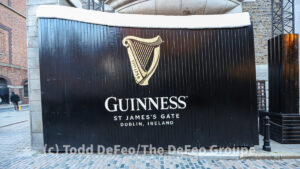
The Guinness Storehouse in Dublin offers visitors an immersive look at the history, heart, and craft behind one of Ireland’s most famous beers. Located inside the original brewery at St. James’s Gate, the Guinness Storehouse includes seven floors of exhibits in a building that once served as the brewery’s fermentation plant. Along the way, visitors learn about the ingredients, heritage, and culture that shaped Guinness into a global icon. The experience concludes at the Gravity Bar, where panoramic 360-degree views of Dublin provide one of the city’s highest and most scenic vantage points.
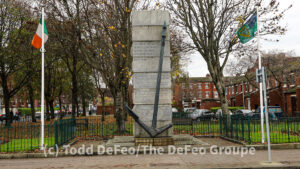
The Irish Merchant Navy Memorial in Dublin commemorates the seamen who died while serving on Irish merchant ships during the Second World War, a period known in Ireland as the Emergency. The memorial stands on City Quay at the corner of Lombard Street East and consists of a granite monument with an anchor set in front, placing it firmly within Dublin’s docklands and its long maritime history.
The monument honors the crews who kept supplies moving to and from neutral Ireland during the war despite the dangers at sea. According to RTÉ, 16 ships were lost between 1939 and 1945, and 149 men died. The service of the Irish mercantile marine during those years became known among mariners as the Long Watch, a phrase that captured both the risk and the endurance of those voyages.
An annual commemoration is still held at the City Quay memorial in November, continuing the site’s role as a place of public remembrance. More than a docklands monument, it marks a wartime story in which Irish seamen helped sustain the country through years of isolation, shortage and uncertainty.
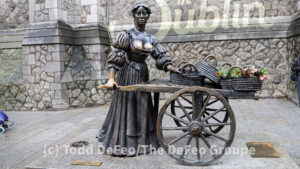
The Molly Malone statue stands on Suffolk Street, steps from Trinity College and Grafton Street. Molly Malone herself is a semi-historical, semi-legendary figure immortalized in the beloved ballad “Cockles and Mussels,” a song sung so widely that it’s often treated as Dublin’s unofficial anthem. Her tragic story — and the image of her pushing her barrow — has become one of the city’s most recognizable symbols.
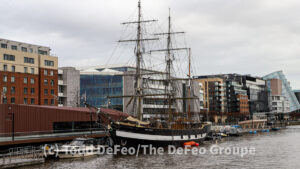
The Jeanie Johnston is a full-scale replica of a 19th-century famine ship located in Dublin’s Docklands. The vessel tells the story of some of the thousands of Irish people who fled the Great Famine and made the dangerous Atlantic crossing in search of a better life in North America. Visitors can step aboard to learn about the cramped conditions, the voyage’s risks, and the resilience of the passengers who undertook this journey into the unknown.