
The Denison Museum at Denison University in Granville, Ohio, serves as a teaching museum built around the liberal arts.
Located on the lower level of Burke Hall, now part of the Eisner Center, since 1973, the museum supports classroom learning through a collection of more than 9,000 objects of cultural, historical, scientific and artistic significance. Rather than functioning only as a gallery space, it is closely tied to the university’s curriculum and emphasizes object-based learning across a wide range of disciplines.
Denison’s art collecting began in 1945, when trustee Edmund G. Burke helped establish a foundation for what would become the museum’s collection. Over time, the holdings expanded well beyond fine art and came to include important materials from East Asia, the Central American Guna culture, Africa and the ancient world. Particularly strong areas include Burmese textiles, Thai and Burmese Buddhas, Japanese netsuke, Chinese rubbings and Guna mola textiles.
43023
The Old Colony Burying Ground was established in 1805 and is the final resting place of many early Granville pioneers. The first burial was in 1806, and the oldest surviving gravestone is dated 1808. It is the resting place for veterans from the Revolutionary War, War of 1812, and Civil War, along with ministers, farmers, industrialists, physicians, mothers, children, and other citizens of Granville.
43023
The Granville Opera House was destroyed by fire on April 7, 1982. The historic edifice was built in 1849 as a Baptist Church and moved to a location at the corner of Broadway (Ohio Route 661) and Main Street in 1882. The church tower’s bell is still on display in a park built on the site of the Opera House. The bell first rung on June 29, 1872, to announce the death of the Reverend Samson Talbot, Denison University’s fifth president. The bell was also know for sounding on the hour and as the fire alarm.
43023
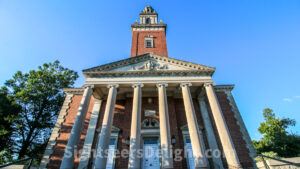
Swasey Chapel at Denison University in Granville, Ohio, has long stood as the visual and ceremonial centerpiece of the campus. Built between 1922 and 1924 as the first building in the university’s ambitious Greater Denison plan of 1917, it honors benefactor and trustee Ambrose Swasey, whose gift helped make the project possible. The chapel’s chimes serve as a memorial to his wife, Lavinia Marston Swasey, adding a personal element to one of the university’s most recognizable landmarks.
Designed by Arnold Brunner in an English Stuart Revival style influenced by the London churches of Sir Christopher Wren, the chapel is built of Bedford limestone and Harvard brick laid in Flemish bond. Its prominent placement on the university’s highest ground, reinforced by the campus landscape plan prepared by Frederick Law Olmsted Sons, gives it a visibility that helps define Denison’s overall appearance.
Although built as a house of worship, Swasey Chapel, which stands 140 feet, 6 5/8 inches tall, not counting the lightning rod, has long served a broader role in university life. It hosts convocations, concerts, speakers, weddings, funerals and other major events, allowing the building to remain central to campus traditions in times of celebration and remembrance alike.
43023