
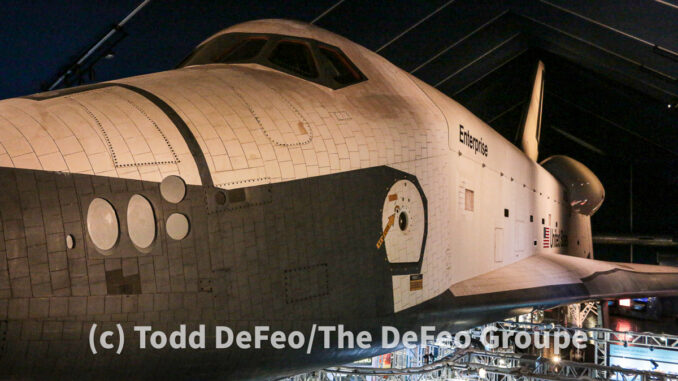
Looking back at the Space Shuttle program, one could be forgiven for thinking that either the Challenger or the Columbia was the first space shuttle. However, it was the Enterprise.
(There was an earlier mock-up, the Pathfinder.)
And its original name wasn’t even the Enterprise, and it couldn’t even make it into space.
On Jan. 5, 1972, President Richard M. Nixon directed NASA to build a partially reusable space transportation system, saying that “it would revolutionize transportation into near space.”
What emerged was Space Shuttle Enterprise, which carries the OV-101 vehicle designation. It was rolled out from its manufacturing plant in Palmdale, California, 50 years ago today, Sept. 17, 1976, Constitution Day. Hence, its original name: Constitution.
However, Star Trek fans had a different idea. They embarked on a letter-writing campaign, asking then-President Gerald Ford to name the orbiter the USS Enterprise, after the famed Star Trek starship.
How many letters they sent is debatable. Regardless, it worked.
As advisor James Cannon noted in a memo, a vessel named the Enterprise served in action against the Barbary pirates in 1803. Another vessel with the name served with the Wasp and the Hornet in the Pacific carrier fleet, and a third Enterprise was the U.S. Navy’s first nuclear carrier.
“It is a distinguished name in American naval history, with a long tradition of courage and endurance,” Ford reportedly said. “It is also a name familiar to millions of faithful followers of the science fiction television program Star Trek. To explore the frontiers of space, there is no better ship than the space shuttle, and no better name for that ship than the Enterprise.”
The shuttle’s purpose was to perform atmospheric test flights after launching from the back of a modified Boeing 747. As such, it was constructed without engines or a functional heat shield, making it incapable of spaceflight.
Originally, the plan was to retrofit Enterprise for orbital flight, and it would have been the second space-rated orbiter in service.
Its maiden spaceflight was scheduled for July 1981. However, during the construction of Space Shuttle Columbia, design details changed, making it simpler and cheaper to build Challenger around a body frame built as a test article.
Similarly, NASA considered refitting Enterprise to replace Challenger after the latter was destroyed. However, NASA opted instead to build Endeavour from structural spares.
The Enterprise also played a role in the investigation of the 2003 Columbia disaster.
The shuttle was displayed in multiple places over the years, including the Smithsonian National Air and Space Museum in the 1980s. It was moved to the Intrepid Museum in New York City in 2012.
“Enterprise is largely intact, has undergone little modification, and contains many of the materials of its original construction,” according to the National Register of Historic Places registration form. “Enterprise, while similar to the other orbiters, is a one of a kind design. As a prototype, Enterprise was designed for specific tasks and its form and plan reflect those requirements. Enterprise has undergone few alterations and therefore still adheres to the design of an orbiter prototype.”



Be the first to comment