
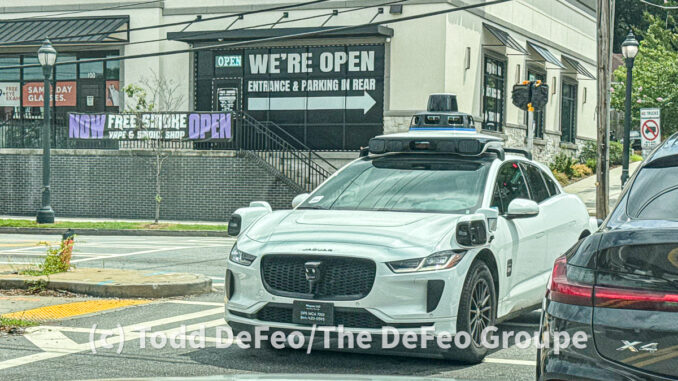
A new Insurance Institute for Highway Safety report found that Waymo’s driverless vehicles were involved in 68% fewer police reportable crashes per vehicle mile traveled than human drivers in the same cities.
According to the report, “Rise of the Machines: Crash Experiences of Highly Automated Vehicles and Human Drivers,” Waymo’s driverless vehicles deployed in San Francisco, Phoenix, Los Angeles and Austin were involved in 68% fewer crashes per vehicle mile traveled than human drivers, researchers found. The sample was restricted to crashes that a person would typically report to the police.
Started in 2009 as the Google self-driving car project, Waymo launched its driverless robotaxi service for the public in Phoenix in 2020, expanded to San Francisco in 2022 and Los Angeles in 2023, and began limited operation in Austin in 2024.
“For years, we have expected autonomous vehicles (AVs) to be flawless while quietly accepting a human driving record that kills more than 36,000 people on our roads every year,” the Governors Highway Safety Association said in a statement. “Innovation and safety are not competing goals. This research is a powerful reminder that progress, not perfection, must be the standard for AVs, just as it has been for seat belts, airbags, automatic emergency braking and every other safety technology that eventually earned the public’s trust.
“This new IIHS research underscores why these technologies should be judged by consistent data collected over millions of miles, not by overreactions caused by a single viral video, isolated incident, or perception of a lack of safety that isn’t supported by data,” GHSA added. “On that basis, the findings are clear: Waymo’s driverless vehicles crashed far less often than the people driving around them. Human drivers will continue to make mistakes, and we should not allow the pursuit of a perfect AV safety record to become a barrier to deploying technologies that are demonstrating the ability to make our roads safer.”
In a statement, IIHS President David Harkey said the results show that, on a limited scale, these driverless cars are safer than human drivers, who might be impaired or drowsy or suffer lapses in attention. However, Harkey said, “the present data collection system isn’t good enough to allow continuous monitoring of a large-scale expansion.”
GHSA added that as AVs become more common, safety officials at all levels need the tools and information to monitor performance, identify emerging safety issues and respond effectively. The group also noted that state highway safety offices will play an important role in helping communities understand these technologies, educating the public and ensuring first responders are prepared to safely interact with autonomous vehicles.
