
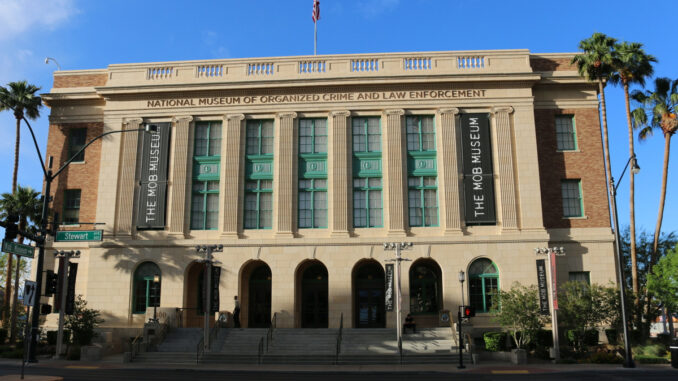
A new exhibit at Las Vegas’ Mob Museum, the National Museum of Organized Crime and Law Enforcement, will examine the still-unsolved murder of one of the most notorious crime figures in American history: mobster Benjamin “Bugsy” Siegel.
The exhibit, “What Bugsy Left Behind,” opens Friday, Nov. 13, and features a never-before-seen collection of Siegel’s personal effects, which the Beverly Hills Police Department held as evidence for nearly 80 years. It will explore the competing theories surrounding his murder while tracing his influence on organized crime in Southern California and the development of midcentury Las Vegas.
On June 20, 1947, Siegel was shot and killed at the Beverly Hills home of his on-again, off-again girlfriend, Virginia Hill, while she was traveling in Europe. The 41-year-old mobster had traveled from Las Vegas to Southern California to reunite with his two daughters for a planned vacation, but he was killed before they could see him.
As one of the Beverly Hills Police Department’s oldest cold cases, his murder remains unsolved nearly eight decades later, with historians continuing to debate who was responsible and why.
Among the leading theories explored in the new exhibit is that Charles “Lucky” Luciano and other powerful Mob figures ordered Siegel’s killing over his handling of the Flamingo Hotel, where lavish spending, disappointing early returns and suspicions of skimming had reportedly angered his underworld investors. Another theory suggests that Siegel was targeted by a rival seeking control of the lucrative race wire, which supplied horse-racing results to bookmaking operations across California, Arizona and Nevada.
A third theory points to one of Hill’s brothers, who may have sought revenge for Siegel’s abusive treatment of his sister.
Siegel was shot while reading an early edition of the Los Angeles Times. Personal effects found on his person and featured in the exhibit include Meyer Lansky’s business card and a wallet-sized photograph of Hill, with the handwritten message, “Sweetheart Benny I love you Pup,” on the back.
The collection’s public debut coincides with two major milestones in that history: the Flamingo Hotel’s 80th anniversary on Dec. 26, 2026, and the approaching 80th anniversary of Siegel’s murder. It also follows a decades-long effort to recover Siegel’s personal belongings from police custody.
Following his death at age 41, the Beverly Hills Police Department retained the items as evidence in its investigation. In 2025, Siegel’s granddaughter Wendy Rosen filed a lawsuit seeking their return to the family. Following the judge-ordered release, the Mob Museum acquired the collection from Rosen.
Born in Brooklyn, New York, in 1906, Siegel rose through the ranks of organized crime during Prohibition, joining forces with Lansky in bootlegging and other illegal enterprises. In the mid-1930s, he moved to Los Angeles, where he helped expand criminal rackets throughout Southern California’s rapidly growing communities while cultivating relationships with Hollywood figures, including actor George Raft.
His influence eventually extended to Las Vegas, where he seized control of the race wire, bought the El Cortez Hotel & Casino, and later helped develop the Flamingo Hotel.

Be the first to comment