
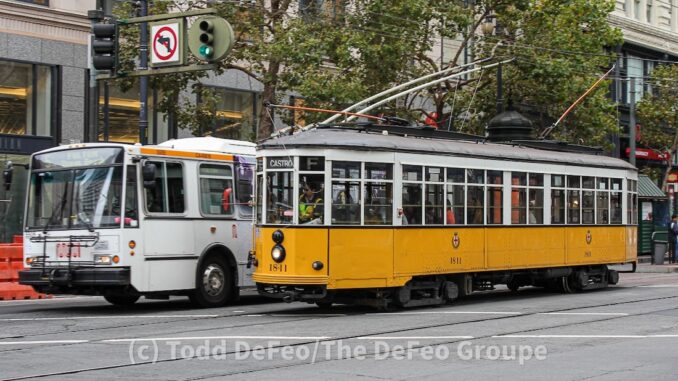
With rising travel costs at the forefront of many Americans’ minds, a recent analysis looks at where people may be able to travel easily without a car.
The team at Solitaire Bliss evaluated public transit systems in the 30 largest U.S. cities, assigning each a “transit accessibility score” based on the number of train and bus stops per mile and per person.
Top transit cities
San Francisco, Washington, D.C., and Portland, Oregon, emerged as the top three cities for public transportation access. San Francisco leads the pack with the most train stops per mile and per person and the highest density of bus stops per mile.
Portland and Detroit tied for the most bus stops per person. Chicago and Boston joined the top ranks alongside San Francisco and D.C., boasting over 40 bus stops per mile.
Where transit falls short
At the bottom of the list were Jacksonville, Florida; Las Vegas, Nevada; and San Antonio, Texas, which all scored poorly on transit availability metrics.
Train accessibility standouts
Six cities — San Francisco, Philadelphia, New York City, Boston, Washington, D.C., and Portland — were noted for having more than one train stop per mile. This includes tram stops, subway stations, and railway stations.
