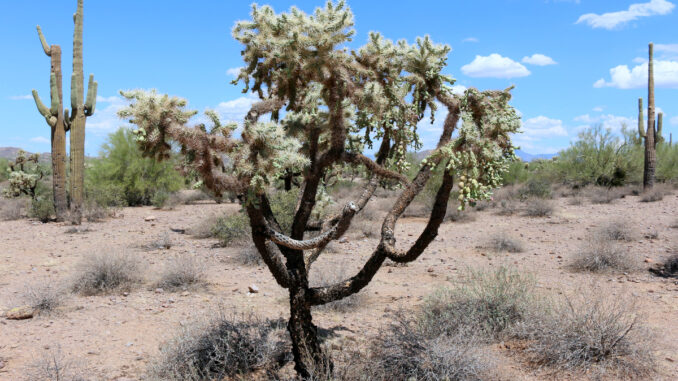
Lost Dutchman State Park in Apache Junction, Ariz. (Photo by Todd DeFeo/The DeFeo Groupe)
Guidebooks are annoying. Just because some editor who doesn’t know me tells me which restaurant is the best or what attraction is a must-see doesn’t make it a must-see attraction. Sightseers’ Delight is dedicated to the weird, the quirky and the fun. After all, traveling is fun.
If it’s not, you’re doing it wrong.
All of the places highlighted in this ever-growing database are great. Sightseers’ Delight has visited them all. We think you should make a point to see every one of them. But, this is not a guidebook. Just a webpage to help you plan your next adventure.
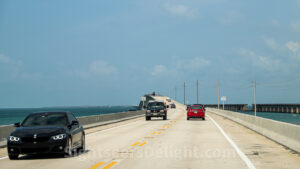
The Overseas Highway is a 113-mile-long highway carrying U.S. Route 1 through the Florida Keys to Key West. It was largely built on parts of the former Overseas Railroad right-of-way, an extension of the Florida East Coast Railway to Key West Extension completed in 1912. The 1935 Labor Day hurricane heavily damaged and partially destroyed the Overseas Railroad. The Florida East Coast Railway was financially unable to rebuild the destroyed sections and sold roadbed and remaining bridges to Florida, making it a famous drive between Miami and Key West.
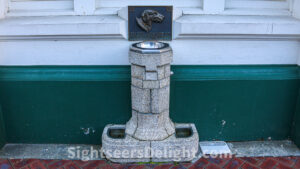
In Wellington, New Zealand, Queens Wharf is home to a monument to a dog who took on a larger-than-life personality. During his life, Paddy the Wanderer, an Airedale Terrier, befriended cabbies, workers and seamen. The Wellington Harbour Board adopted Paddy and bestowed him the title of the assistant night watchman. Paddy was tasked with keeping guard against “pirates, smugglers and rodents.” After he died on July 17, 1939, at Harbour Shed no. 1, the locals honored Paddy with a parade. In 1945, Paddy’s friends built a memorial to the pooch with stones from London’s Waterloo Bridge, bombed during World War II. It includes a bronze likeness, a drinking fountain and drinking bowls below for dogs.
Palazzo Ducale (or the Doge’s Palace in English) is the former residence of the Doge of Venice, the supreme authority in the former Venetian Republic. The old palace opened as a museum in 1923. Doge Agnello Participazio moved the seat of the Venetian government to the current location from the island of Malamocco in 810. Construction on the existing building began circa 1340.
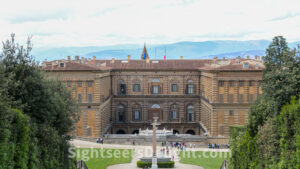
The Palazzo Pitti or Pitti Palace dates to 1458 and was the town residence of Luca Pitti, a Florentine banker. The Medici family bought the place, which is on the south side of the River Arno, a short distance from the Ponte Vecchio, in 1549. It served the main home of the ruling families of the Grand Duchy of Tuscany and grew as a great treasure house. Later generations amassed paintings, plates, jewelry and luxurious possessions. Napoleon used the palace in the late 18th century, and King Victor Emmanuel III donated the building and its contents to the Italian people in 1919.
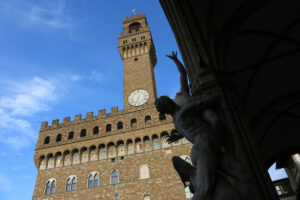
Palazzo Vecchio, which translates to Old Palace, is Florence’s town hall. The historic edifice is adjacent to the Piazza della Signoria and a copy of Michelangelo’s famed David statue; the Galleria dell’Accademia houses the original. It also overlooks the Loggia dei Lanzi, effectively an outdoor art gallery. Visitors who hike to the top of the Palazzo Vecchio’s bell tower are rewarded with stunning views of the city.
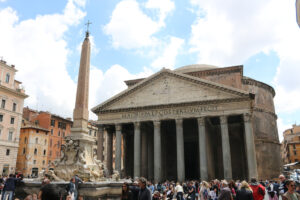
Started in 27 BC, the Pantheon, built as a temple to the ancient Roman gods, is considered by many to be the glory of Rome. The building has it all, from columns to marble to monuments. Without a doubt, it is a testament to Rome’s grandeur and illustrious past.
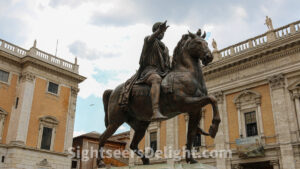
Piazza del Campidoglio is an Italian square at its finest. Designed by Michelangelo, the original Renaissance man, the Piazza is a great place for the weary traveler to take a respite and lose oneself in the moment.
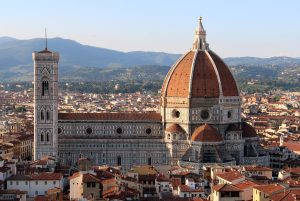
Though it’s somewhat of a hike from the touristy parts of Florence, Piazzale Michelangelo is well worth the steps. Despite its name, Michelangelo did not design the piazza. Florentine architect Giuseppe Poggi did in 1869; it is merely named in honor of Michelangelo and features a replica of David, the man who is ever-present throughout Florence. The park offers stunning views of the city and the Arno river.