
Guidebooks are annoying. Just because some editor who doesn’t know me tells me which restaurant is the best or what attraction is a must-see doesn’t make it a must-see attraction. Sightseers’ Delight is dedicated to the weird, the quirky and the fun. After all, traveling is fun.
If it’s not, you’re doing it wrong.
All of the places highlighted in this ever-growing database are great. Sightseers’ Delight has visited them all. We think you should make a point to see every one of them. But, this is not a guidebook. Just a webpage to help you plan your next adventure.
Formerly the Hiroshima Prefecture Industrial Promotion Hall, this building was completed in April 1915, and was located near the bomb’s hypocenter. It is one of the few buildings to survive the blast. Historic photographs of the city show a landscape flattened by the blast, with just a few structures still standing — one being the shell of the Industrial Promotion Hall. But, the building, which has not changed significantly since the bombing, is just one of a few important landmarks dedicated to Aug. 6, 1945.
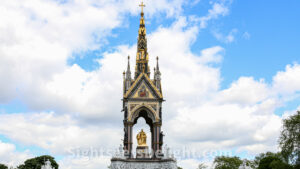
The Albert Memorial, located north of the Royal Albert Hall in Kensington Gardens, London, was constructed in honor of Prince Albert, Queen Victoria’s dear husband, who passed away in 1861. Sir George Gilbert Scott designed the ornate pavilion, which stands at a height of 176 feet (54 m) and resembles a Gothic ciborium over the high altar of a church. Inside the pavilion, there is a south-facing statue of Prince Albert. It took more than ten years to construct and was funded by public subscription, costing £120,000 (roughly £10 million in 2010). The Queen inaugurated the memorial in July 1872, and the statue of Albert was ceremonially “seated” in 1876, and it was classified as Grade I in 1970.
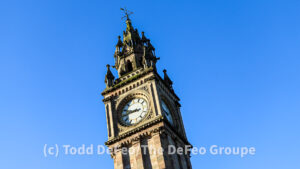
The Albert Memorial Clock, erected in 1865, is one of Belfast’s best-known attractions. Built in a Gothic style to commemorate Prince Albert, the Albert Memorial Clock was built on reclaimed land along the River Lagan, a foundation that caused its well-known tilt. Standing 113 feet high, it once provided an elevated vantage point that allowed at least one onlooker to view the launch of RMS Titanic. The tower includes a statue of Prince Albert, ornate carved details such as crowned lions and floral motifs, and houses a two-tonne bell in its upper section.
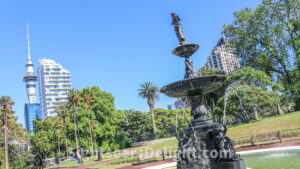
Albert Park was laid out in the 1880s and is famous for its stunning views of Auckland and the harbor. The park stands on the site of the former Albert Barracks, which was built in the 1840s and is among Auckland’s early European military forts, which itseld was buolt on the site of Te Horotiu pa. A statue of Queen Victoria was erected in the park following her Diamond Jubilee in 1897. The park is also home to a Boer War memorial.
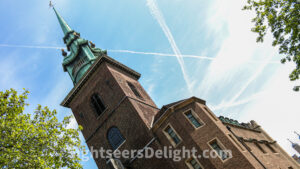
All Hallows-by-the-Tower is a historic Anglican church located on Byward Street in the City of London, England. It was dedicated to All Hallows (All Saints) and the Virgin Mary and was sometimes called All Hallows Barking. According various sources, it is believed to be the oldest church in the City of London, founded in AD 675. However, recent research has cast doubt on this claim. Despite surviving the Great Fire of London in 1666, the church suffered significant damage during the Blitz in World War II. It underwent extensive reconstruction and was rededicated in 1957. The church served as the guild church of Toc H, an international Christian organization founded by Tubby Clayton, who served as the church’s vicar from 1922 to 1962.
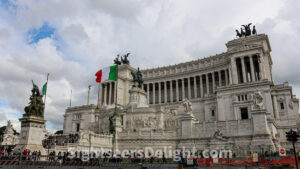
The Altare della Patria (or Altar of the Fatherland) is perhaps better known as the Monumento Nazionale a Vittorio Emanuele II (or the National Monument to Victor Emmanuel II). Many also call it the Wedding Cake. Sitting between Piazza Venezia and the Capitoline Hill, it was built to honor Victor Emmanuel II, the first king of a unified Italy. The monument is also the location of the Tomb of the Unknown Soldier and features an eternal flame and the museum of Italian Unification.
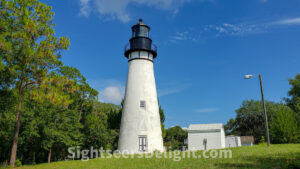
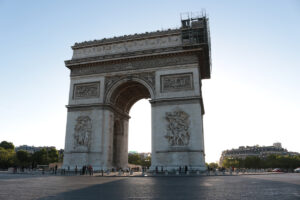
Construction on the Arc de Triomphe de l’Étoile started in 1806 and lasted until 1836. Located in the Place Charles de Gaulle and at the western end of the Champs-Élysées, the Arc honors French soldiers who died fighting for France during the French Revolutionary and the Napoleonic wars. The Tomb of the Unknown Soldier from World War I is beneath the Arc, which was the tallest triumphal arch in the world until 1938.
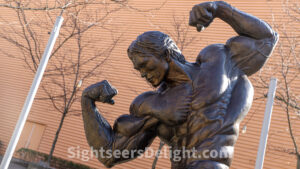
The statue of Arnold Schwarzenegger sits outside the Greater Columbus Convention Center, where it has stood since 2014. The bronze sculpture was originally erected outside the Franklin County Veterans Memorial in 2012, before being relocated and rededicated to its current location. Schwarzenegger, Ohio Gov. John Kasich, and Columbus Mayor Michael B. Coleman attended the ceremony.