
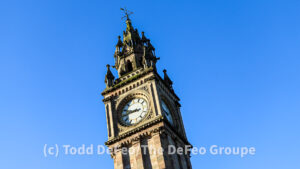
The Albert Memorial Clock, erected in 1865, is one of Belfast’s best-known attractions. Built in a Gothic style to commemorate Prince Albert, the Albert Memorial Clock was built on reclaimed land along the River Lagan, a foundation that caused its well-known tilt. Standing 113 feet high, it once provided an elevated vantage point that allowed at least one onlooker to view the launch of RMS Titanic. The tower includes a statue of Prince Albert, ornate carved details such as crowned lions and floral motifs, and houses a two-tonne bell in its upper section.
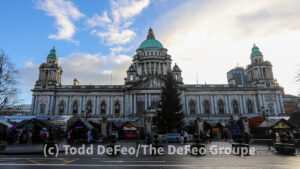
Belfast City Hall, one of the city’s most iconic buildings, opened in August 1906 and remains the center of civic life. Visitors can explore the City Hall’s stained-glass windows, artworks, and outdoor monuments using the City Hall app, which offers guided and self-guided tours. The grounds feature the Titanic Memorial Garden and several notable memorials. City Hall also offers three function rooms available through an application process.
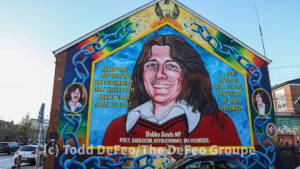
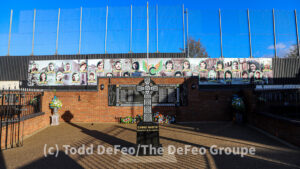
The Clonard Martyrs Memorial Garden on Bombay Street in west Belfast is one of the area’s best-known memorial sites connected to the Troubles.
Located near the Falls-Shankill interface, it commemorates IRA members, former prisoners, political activists and civilians from the Clonard area. The garden is divided into three linked sections, enclosed by walls, railings and gates, with a large Celtic cross and a central plaque in the middle section and additional plaques and memorial benches in the side sections.
Its location on Bombay Street gives the site added historical significance. In August 1969, during some of the earliest large-scale violence of the Troubles in Belfast, Catholic houses on Bombay Street were burned, making the street one of the best-known flashpoints of that period. Gerald McAuley, a 15-year-old member of Fianna Éireann, was killed during the attack while helping people flee.
The memorial garden was created by the Greater Clonard Ex-Prisoners’ Association in the early 2000s.
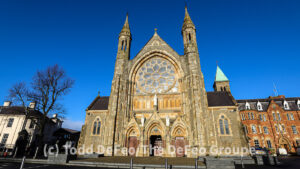
Clonard Monastery, built in 1911 to replace a small brick church on Clonard Street, is now one of Ireland’s best-known churches and the home of the annual Clonard Novena, which draws thousands of visitors each year. The building served as a shelter during the Belfast Blitz in World War II, protecting residents from bombing raids. Decades later, it became a key location in the Northern Ireland peace process, hosting private discussions between Fr Alec Reid, Gerry Adams and John Hume. These meetings helped advance dialogue and earned the monastery the title “The Cradle of Peace.”
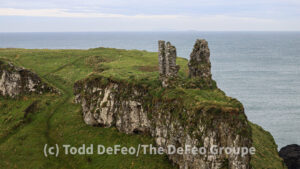
Dunseverick Castle is the site of an ancient stronghold on the Causeway Coast, with archaeological evidence of an Iron Age promontory fort and a long tradition identifying it as the northern endpoint of one of Ireland’s five great roads. Saint Patrick is said to have visited the site in the 5th century, baptizing Olcán, who later became a bishop. The fort was attacked by Viking raiders in 870 AD, and in the 6th century it served as the seat of Fergus Mór MacEirc, King of Dál Riata, a figure linked to the departure of the Lia Fáil to Scotland. The castle later passed to the Earls of Ulster, the O’Cahans and the McDonnells before being destroyed in the 1640s. Today, only the gate lodge ruins remain.
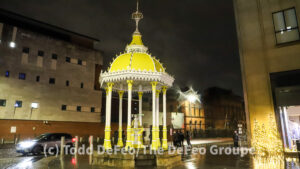
The Jaffe Fountain dates to 1874, the same year as the death of its namesake, Daniel Joseph Jaffe, a German merchant who arrived in Belfast in 1850 to establish a linen export business. The fountain originally stood in Victoria Square, where it commemorated Jaffe’s role as the founder of Belfast’s Jewish community and the builder of the city’s first synagogue in 1871. In 2007, the monument was taken to Shropshire, England, for restoration due to its deteriorated condition and was returned to its original location in February 2008. Jaffe’s legacy also includes his son, Otto Jaffe, who served twice as Lord Mayor of Belfast and remains the city’s only Jewish Lord Mayor.
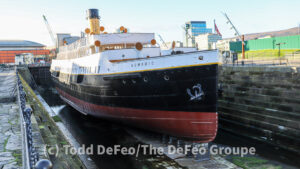
SS Nomadic was one of two vessels the White Star Line commissioned in 1910 to transport passengers to the new ocean liners RMS Olympic and RMS Titanic. The vessels were too large to dock in Cherbourg Harbour, necessitating the SS Nomadic and a sister vessel, the SS Traffic. It has been fully restored to her original 1911 appearance. Best known for transferring first- and second-class passengers to the Titanic at Cherbourg, Nomadic went on to serve in multiple roles over its career. Now back in Belfast, where she was designed and built, the ship is preserved in Hamilton Dock as a major visitor attraction. Spread across four decks, the experience offers an authentic sense of what it was like to board the Titanic, highlighting original design details and the clear distinctions between class areas.
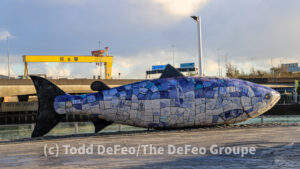
The Big Fish is a 32-foot salmon sculpture commissioned in 1999 to mark the regeneration of the River Lagan and the historic significance of its waterfront location. Created by artist John Kindness, the sculpture is covered in blue ceramic tiles depicting different chapters of Belfast’s history. Located beside the river near the Customs House and Lagan Lookout, it has become a popular piece of public art, inviting visitors to take a closer look—and a photo—while exploring the city’s story.
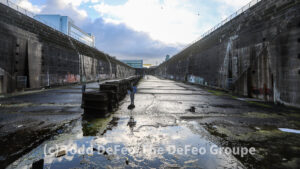
Thompson Graving Dock is best known as the dry dock where RMS Titanic was fitted out before departing on her maiden voyage in April 1912. Also referred to as Thompson Dry Dock or simply Thompson Dock, it was built to support the construction of the new generation of large ocean liners emerging in the early 20th century. Work began in October 1903 beside Alexandra Dock, based on designs produced by the Belfast Harbour Commission and carried out by contractors Walter Scott & Middleton. Although originally scheduled for completion in just over three years, ground subsidence and other delays extended construction to eight years. Costing £350,000, the dock officially opened on April 1, 1911, and remains one of Belfast’s most significant engineering landmarks.