
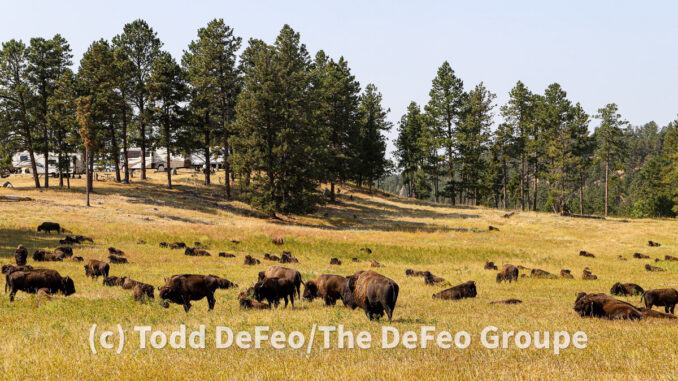
CUSTER, South Dakota (Sightseers’ Delight) — South Dakota loves calling itself the “land of infinite variety,” which usually means “we have a lot of rocks, grass, and very aggressive wind.” But inside Custer State Park, the slogan actually holds up.
With more than 2 million visitors dropping by annually, Custer State Park easily proves that South Dakota’s best attraction isn’t carved out of granite—it’s walking around eating the grass right beside it.
Sprawling across 71,000 acres of the Black Hills, South Dakota’s oldest state park packs in granite spires, mountain lakes, and enough scenic drives to keep flatlanders gripping their steering wheels in terror.
The park’s history began in 1919, but its smartest move came in 1914, when officials bought 36 bison from a local rancher. Today, that herd has exploded to roughly 1,400 massive, unpredictable beasts that regularly cause total gridlock along the park’s loop roads. If you prefer your wildlife slightly less dangerous, the resident herd of “begging burros”—feral donkeys that aggressively solicit snacks from idling minivans—is always ready for a photo-op.
Getting around the park is an adventure in itself. Engineers threw out traditional roadbuilding rules in 1922 to open Needles Highway, carving narrow tunnels directly through towering granite spires. A decade later, the Civilian Conservation Corps finished Iron Mountain Road, a mind-bending 17-mile stretch of pigtail bridges and switchbacks designed specifically to frame views of nearby Mount Rushmore through its tunnels.
The park has hosted its share of VIPs over the decades. President Calvin Coolidge famously spent his summer at the State Game Lodge in 1927, breaking his trademark silence to declare he had “a good time.”
Meanwhile, the annual Buffalo Roundup—started in 1965 to manage the herd—now draws thousands of spectators every fall to watch local cowboys chase tons of thundering beef across the plains.



Be the first to comment