
Guidebooks are annoying. Just because some editor who doesn’t know me tells me which restaurant is the best or what attraction is a must-see doesn’t make it a must-see attraction. Sightseers’ Delight is dedicated to the weird, the quirky and the fun. After all, traveling is fun.
If it’s not, you’re doing it wrong.
All of the places highlighted in this ever-growing database are great. Sightseers’ Delight has visited them all. We think you should make a point to see every one of them. But, this is not a guidebook. Just a webpage to help you plan your next adventure.
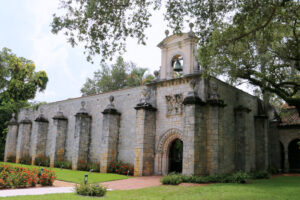
The Ancient Spanish Monastery, officially St. Bernard de Clairvaux Church, was originally built in the Spanish town of Sacramenia in Segovia in the 12th century and named Santa María la Real. It was closed some time between 1836 and 1840 during the reign of Isabella II of Spain and as a result of the Ecclesiastical Confiscations of Mendizábal. William Randolph Hearst purchased the structure in 1925 and was subsequently dismantled and shipped to the United States. However, as a result of an outbreak of hoof and mouth disease in Segovia, the 11,000 crates containing the historic monastery building were quarantined in New York. Though he planned to relocate it to his Hearst Castle in San Simeon, because of Hearst’s financial difficulties, the building remained in storage in New York. Raymond Moss and William Edgemon purchased the building in 1952, a year after Hearst died. The building was re-assembled on a plant nursery north of Miami.
33160
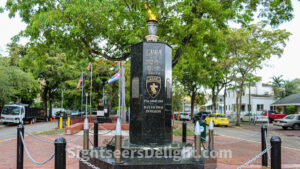
The Bay of Pigs Monument is a tribute to the soldiers who lost their lives in the Bay of Pigs Invasion that took place in Little Havana, Miami, Florida. The monument features the names of the fallen soldiers engraved on it, and an eternal flame burns on the top as a symbol of their courage. The monument was dedicated on April 17, 1971, by several hundred Cuban exiles, Miami Mayor David T. Kennedy, and then-Senator Lawton Chiles. President Richard Nixon sent his best wishes for the occasion via cable.
33135
33132
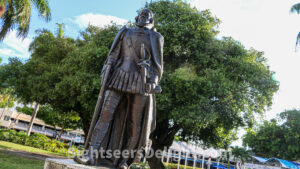
The Spanish government donated this statue of Juan Ponce de León in 1976. It stands in Bayfront Park and was re-dedicated on May 22, 1995.
33132
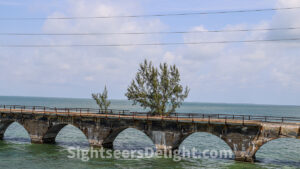
The Seven Mile Bridge is perhaps the most famous bridge on the 113-mile-long Overseas Highway through the Florida Keys to Key West. The Florida East Coast Railway build the original bridge, initially known as the Knights Key-Pigeon Key-Moser Channel-Pacet Channel Bridge, from 1909 to 1912 as part of its Key West Extension, also known as the Overseas Railroad. Following the 1935 Labor Day hurricane, the railroad, financially unable to rebuild the route, sold the remaining bridges to the government, which reworked it as a highway. A newer bridge, constructed from 1978 to 1982, replaced the original span, which largely remains in place.
33050
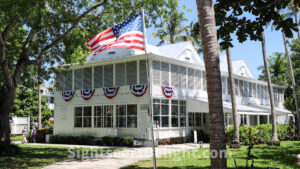
The Harry S. Truman Little White House in Key West, Florida, is a historic building that served as the winter White House of President Harry S. Truman during his presidency. Originally built in 1890 as the naval station’s command headquarters during the Spanish-American War, it was later used as a vacation home by several presidents before Truman. The house is now a museum that is open to the public for tours, which offer visitors a glimpse into the life of Truman and other presidents who stayed at the house. The museum features exhibits, artifacts, and photographs that highlight the history of the house and its famous occupants.
This post incorporates text generated with GPT-3, OpenAI’s large-scale language-generation model.
33040
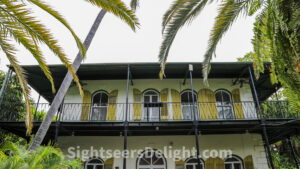
Pulitzer and Nobel Prize-winning author Ernest Hemingway and his wife, Pauline Pfeiffer, lived in a house at 907 Whitehead Street from 1931 to 1939. Asa Tift, a marine architect and salvage wrecker, built the house in a French Colonial estate style. Construction on the house started in 1848 and completed in 1851. When Pauline first saw the house in deep disrepair, she labeled it a “damned haunted house.” However, she convinced her wealthy uncle to buy it for $8,000 for her and her husband as a wedding present. Today, the Ernest Hemingway Home and Museum in Key West, Florida, is equal parts shrine to Hemingway and a historic house. The house, a National Historic Landmark, showcases Hemingway’s possessions, including his writing desk, hunting trophies and books. It is also famous for its resident cats, many of which are descendants of Hemingway’s original pet cats and are said to have six toes.
33040
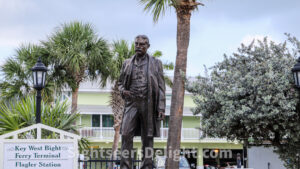
33040
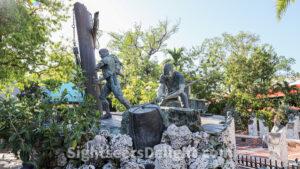
The Key West Memorial Sculpture Garden, located in Mallory Square, features bronze busts of locals who had had a significant impact on Key West, including Henry Flagler, Ernest Hemingway and Tennessee Williams. It originally featured 39 bronze busts but has space to increase to 72 busts. The city of Key West established the garden and the criteria for inclusion in the memorial, which opened in 1997. “The Wreckers” monument stands at the Key West Memorial Sculpture Garden’s center.
33040
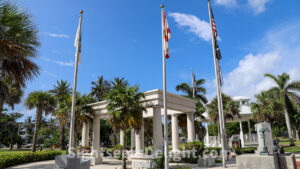
The Key West Veterans Memorial Garden is located in Bayview Park and commemorates those who served and sacrificed for the country. The garden, located in Bayview Park, opened in 2015. It includes placks with information about wars involving American soldiers. The garden also includes the Civil War Forgotten Soldier Memorial, unveiled in 2016 and honoring the more than 120 black soldiers from Key West who served the Union during the conflict.
33040