
Guidebooks are annoying. Just because some editor who doesn’t know me tells me which restaurant is the best or what attraction is a must-see doesn’t make it a must-see attraction. Sightseers’ Delight is dedicated to the weird, the quirky and the fun. After all, traveling is fun.
If it’s not, you’re doing it wrong.
All of the places highlighted in this ever-growing database are great. Sightseers’ Delight has visited them all. We think you should make a point to see every one of them. But, this is not a guidebook. Just a webpage to help you plan your next adventure.
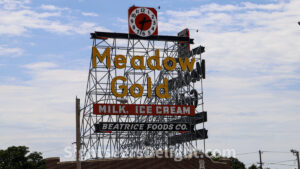
The Meadow Gold Dairy neon sign was installed in the 1930s and has since become an iconic landmark of Route 66. When the building it was originally attached was scheduled to be demolished, the community rallied together to save and restore the sign. Today, it stands on a pavilion built specifically for it, one mile from its original location. Visitors can explore the history of the sign by checking out the plaques on the pavilion.
74120
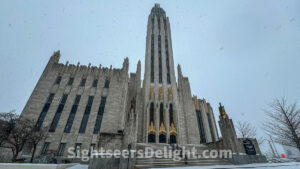
Boston Avenue United Methodist Church is a historically significant church in downtown Tulsa, Oklahoma. Established in 1893, our congregation comprises more than 7,500 members from various backgrounds. The church building was built in 1929 and is recognized as one of the most exceptional examples of Art Deco architecture for ecclesiastical purposes in the United States. It has been listed on the National Register of Historic Places and designated a National Historic Landmark.
74119
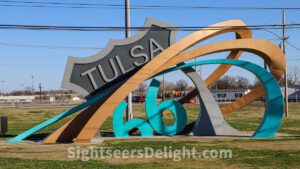
Tulsa’s Route 66 Rising is an iconic sculpture celebrating the Mother Road’s history and impact on Tulsa. The 70-foot by 30-foot structure was dedicated in 2019 and sits along the Mother Road’s original 1926-1932 alignment. The artist behind this historic piece, Eric F. Garcia, was inspired by the Dust Bowl-era Depression and the Mother Road’s message of hope. Located inside the Cyrus Avery Traffic Circle, named after “The Father of Route 66.” It celebrates the contributions of Tulsan Cyrus Avery to Route 66.
74116
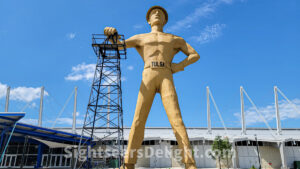
The Golden Driller is a 75-foot-tall statue of an oil worker and is said to be the sixth-tallest statue in the United States. The steel frame structure is covered with concrete and plaster and weighs 43,500 pounds. The Mid-Continent Supply Company of Fort Worth built the initial version in 1952 for the International Petroleum Exposition, and it re-appeared again for the 1959 show. While it was a temporary feature, the company donated the statue to the Tulsa County Fairgrounds Trust Authority, which had it redesigned and permanently installed in front of the Tulsa Expo Center for the 1966 International Petroleum Exposition. The statue rests his right hand on an oil derrick that had been moved from a depleted oil field in Seminole, Oklahoma. The statue has stood in front of the Tulsa Expo Center since 1966.
74114
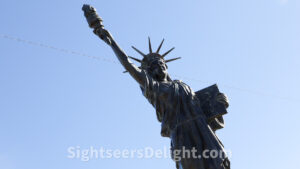
The Boy Scouts of America’s Statue of Liberty replica in Tulsa, Oklahoma, is one of the many copies installed across the country in 1950 as part of the organization’s 40th Anniversary Crusade to Strengthen the Arm of Liberty. Located at the intersection of Harvard Avenue and 17th Street, the Tulsa monument reflects a postwar effort to link civic life, patriotism and public education through a familiar national symbol.
Tulsa’s replica was unveiled on May 7, 1950, before a crowd of about 1,000 people. Local Cub Scouts and Boy Scouts raised money for the project through odd jobs and Scouting activities, with additional support coming from Lanier School students, the school’s PTA and other community groups. A stone base was added, bringing the total cost to $612.
U.S. District Court for the Northern District of Oklahoma Judge Royce H. Savage delivered the dedicatory address, and local school and civic leaders took part in the ceremony. The inscription describes the statue as a pledge of “everlasting fidelity and loyalty,” tying it directly to the ideals the project was meant to represent.
74112
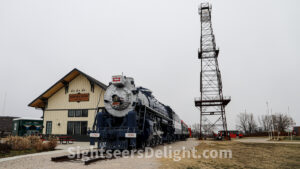
Route 66 Historical Village is an open-air museum highlighting Tulsa’s oil, refining and transportation history. The Visitor’s Center replicates a 1920s Phillips 66 gas station, and the museum is also home to the tallest oil derrick in North America, a Pullman passenger car commissioned in 1929 and Frisco 4500, a 4-8-4 steam engine that pulled the the St. Louis-San Francisco Railway’s Meteor passenger train. In 1901, oil was discovered on former Creek land, which led to Tulsa becoming known as the “Oil Capital of the World,” and the derrick sits on the southeast corner of the Sue Bland No. 1 oil lease. The Route 66 Village was created as part of a partnership called Vision 2025, which, in part, aims to rebuild the Historic Route 66 Highway, through Tulsa County.
74107
74106
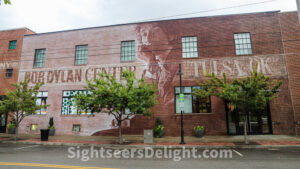
The Bob Dylan Center is located in Tulsa’s burgeoning arts district, just steps from the city’s Woody Guthrie Center. The Bob Dylan Center features cutting-edge and immersive technology in a multimedia environment designed to impress visitors new to Dylan and long-time fans and aficionados. Visitors can listen to rare recordings, watch rarely seen videos and view one-of-a-kind memorabilia ad artifacts that tell the story of “the poet laureate of rock and roll.” The Bob Dylan Center and the Woody Guthrie Center operate under the auspices of the American Song Archives, a project of the George Kaiser Family Foundation. The foundation acquired Dylan’s archives in 2016 and Guthrie’s in 2010.
74103
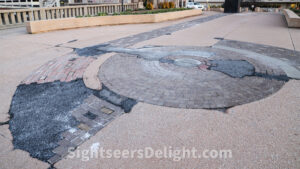
The Center of the Universe is a unique concrete circle in Tulsa with an acoustic anomaly. The circle is a little over eight feet in diameter, and any noise inside it echoes loudly. However, only those inside the circle can hear the echo. Surprisingly, these loud sounds cannot be heard from outside the perimeter of the brick structure. Visitors can access downtown Tulsa’s Center of the Universe through a brick path leading visitors from the Boston Avenue pedestrian overpass.
74103
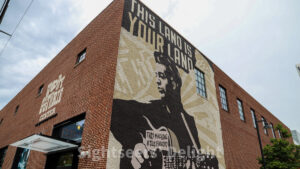
The Woody Guthrie Center, opened in 2013, is dedicated to spreading Woody Guthrie’s message of diversity, equality and justice to a new generation who can create their own ripples of change. The center honors Guthrie’s life and legacy by educating visitors, teachers, students and scholars about his relevance today and his important role in American history through on-site programming, classroom materials, youth music programs, artist-in-residence programs, school outreach, internships, fellowship opportunities and the Woody Guthrie Archives.
74103